Modern Physics Explained: Relativity, Quantum Theory and Nuclear Physics
Quick answer
Modern physics is the physics developed after about 1900 to explain things classical physics could not: objects moving close to the speed of light, and particles as small as atoms. Its two pillars are Einstein’s theory of relativity and quantum theory, and it also covers nuclear physics.
Key takeaways
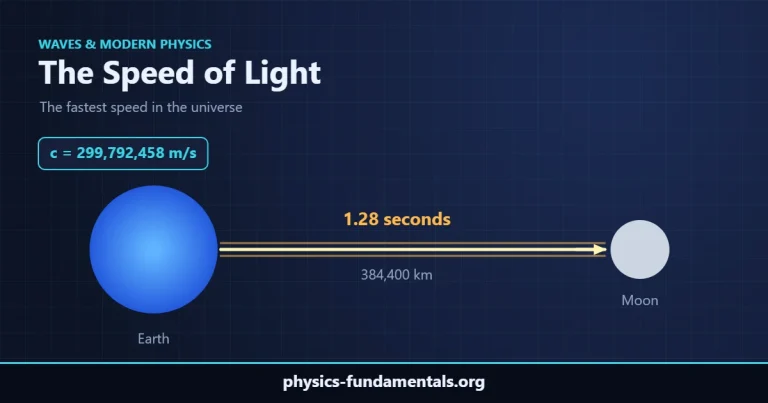
- The speed of light in a vacuum, c ≈ 3.0 × 10⁸ m/s, is the same for every observer.
- Moving clocks run slow and mass and energy are equivalent: E = mc².
- Light comes in packets called photons with energy E = hf.
- Particles such as electrons also behave like waves: λ = h ÷ p.
- Unstable nuclei decay randomly, but a sample always halves in a fixed time called the half-life.
By the end of the 1800s, many scientists thought physics was almost finished. Then a few small puzzles refused to fit: the colour of glowing hot objects, the way light knocks electrons out of metal, and the fixed speed of light. Solving them led to the two biggest revolutions in science, relativity and quantum theory.
Modern physics can sound strange, but its core ideas are simple to state. This guide explains them in plain language, with the key equations and short worked examples. You will see where the ideas came from and why they matter for GPS, lasers, solar panels, medical scanners and nuclear power.
What Is Modern Physics?
Modern physics is the collection of theories that describe nature at very high speeds and very small scales. Classical mechanics still works perfectly for cars and cannon balls, but it fails near the speed of light and inside atoms. Modern physics fixes these gaps while agreeing with classical physics in everyday situations.
| Area | Main question | Key idea |
|---|---|---|
| Special relativity | What happens near the speed of light? | Time and length depend on the observer; E = mc² |
| Quantum physics | How do tiny particles behave? | Energy comes in packets; particles act like waves |
| Atomic physics | How are atoms built? | Electrons sit in fixed energy levels |
| Nuclear physics | What holds the nucleus together and why does it decay? | Binding energy, radioactivity, fission and fusion |
Special Relativity and E = mc²
In 1905, Albert Einstein based special relativity on two simple rules: the laws of physics are the same for everyone moving at a constant velocity, and the speed of light in a vacuum is the same for every observer. Accepting both rules leads to surprising results.
- Time dilation: a moving clock ticks more slowly than a clock at rest.
- Length contraction: a moving object is shorter in its direction of motion.
- A speed limit: nothing with mass can reach the speed of light.
γ = 1 ÷ √(1 − v² ÷ c²) and t = γt₀
γ (the Lorentz factor) tells you how strong the effects are. t₀ is the time measured by a clock moving with the object, and t is the time measured by an observer watching it pass.
Worked example: time dilation
Question: A spaceship travels at 0.8c. A clock on board measures 10 s. How long does this take for an observer on Earth?
- γ = 1 ÷ √(1 − 0.8²) = 1 ÷ √0.36 = 1 ÷ 0.6.
- γ ≈ 1.67.
- t = γt₀ = 1.67 × 10.
Answer: About 16.7 s pass on Earth while 10 s pass on the ship.
E = mc²
Mass and energy are two forms of the same thing. A tiny amount of mass holds a huge amount of energy because c² is so large.
Worked example: energy in one gram
Question: How much energy is equivalent to 1 g of mass?
- Convert: m = 0.001 kg.
- E = mc² = 0.001 × (3.0 × 10⁸)².
- E = 0.001 × 9.0 × 10¹⁶.
Answer: E = 9.0 × 10¹³ J, roughly the energy released by a very large explosion.
Tip: GPS satellites must correct for relativity every day. Without it, positions on your phone would drift by kilometres.
Photons and the Photoelectric Effect
In 1900, Max Planck suggested that energy is given out in small packets called quanta. Einstein went further and said light itself is made of packets, now called photons.
E = hf = hc ÷ λ
h = 6.63 × 10⁻³⁴ J·s is Planck’s constant. Higher frequency (shorter wavelength) means more energy per photon.
Worked example: energy of a photon
Question: Find the energy of a photon of green light with a wavelength of 500 nm.
- E = hc ÷ λ.
- E = (6.63 × 10⁻³⁴ × 3.0 × 10⁸) ÷ (500 × 10⁻⁹).
- E ≈ 3.98 × 10⁻¹⁹ J. Divide by 1.6 × 10⁻¹⁹ to convert to electronvolts.
Answer: About 4.0 × 10⁻¹⁹ J, or roughly 2.5 eV.
When light shines on a metal, it can knock out electrons. This is the photoelectric effect. The wave model could not explain why dim blue light ejects electrons while bright red light may not. The photon model explains it: each electron absorbs one photon, and only photons with enough energy can free it.

KEmax = hf − φ
φ (the work function) is the minimum energy needed to free an electron from the metal. Below a threshold frequency, no electrons are released however bright the light.
Worked example: the photoelectric equation
Question: Photons of energy 4.0 eV hit a metal with a work function of 2.3 eV. What is the maximum kinetic energy of the emitted electrons?
- Use KEmax = hf − φ.
- KEmax = 4.0 − 2.3.
- KEmax = 1.7 eV.
Answer: 1.7 eV, which is about 2.7 × 10⁻¹⁹ J.
Einstein won the 1921 Nobel Prize for this explanation, and solar panels and camera sensors rely on the same physics.
Wave–Particle Duality
If light waves can act like particles, can particles act like waves? Louis de Broglie said yes. Every moving particle has a wavelength.
λ = h ÷ p = h ÷ mv
p is momentum. For everyday objects the wavelength is far too small to notice, but for electrons it is about the size of an atom.
Worked example: electron wavelength
Question: Find the de Broglie wavelength of an electron (m = 9.11 × 10⁻³¹ kg) moving at 1.0 × 10⁶ m/s.
- p = mv = 9.11 × 10⁻³¹ × 1.0 × 10⁶ = 9.11 × 10⁻²⁵ kg·m/s.
- λ = h ÷ p = 6.63 × 10⁻³⁴ ÷ 9.11 × 10⁻²⁵.
- λ ≈ 7.3 × 10⁻¹⁰ m.
Answer: About 0.73 nm, similar to the spacing of atoms in a crystal, so electrons diffract through crystals.
The Heisenberg uncertainty principle follows from this wave nature: you cannot know both the exact position and the exact momentum of a particle at the same time.
Atoms and Energy Levels
Ernest Rutherford’s gold foil experiment in 1911 showed that an atom has a tiny, dense, positive nucleus with electrons around it. Niels Bohr then proposed that electrons can only occupy certain energy levels. When an electron drops to a lower level, it gives out a photon with exactly the energy difference.
En = −13.6 ÷ n² eV
For hydrogen, n = 1 is the ground state. The energy is negative because the electron is bound to the nucleus.
Worked example: a hydrogen spectral line
Question: An electron in hydrogen falls from n = 3 to n = 2. What is the energy of the emitted photon?
- E₃ = −13.6 ÷ 9 ≈ −1.51 eV.
- E₂ = −13.6 ÷ 4 = −3.40 eV.
- Photon energy = E₃ − E₂ = −1.51 − (−3.40).
Answer: About 1.89 eV, which is red light with a wavelength near 656 nm.
Because each element has its own energy levels, each gives out its own set of colours. Astronomers use these line spectra to find out what distant stars are made of.
Nuclear Physics: Radioactivity and Half-Life
The nucleus contains protons and neutrons. Atoms of the same element with different numbers of neutrons are called isotopes. Some isotopes are unstable and decay by giving out radiation.
| Radiation | What it is | Stopped by | Ionising power |
|---|---|---|---|
| Alpha (α) | 2 protons + 2 neutrons (a helium nucleus) | Paper or a few cm of air | High |
| Beta (β⁻) | A fast electron from the nucleus | A few mm of aluminium | Medium |
| Gamma (γ) | A high-energy electromagnetic wave | Thick lead or concrete | Low |
Decay is random, so you cannot predict when one nucleus will decay. However, a large sample always behaves predictably. The half-life is the time for half the unstable nuclei in a sample to decay.
Worked example: half-life
Question: A sample contains 80 g of a radioactive isotope with a half-life of 5 days. How much remains after 15 days?
- 15 days ÷ 5 days = 3 half-lives.
- 80 g → 40 g → 20 g → 10 g.
- Equivalently, remaining = 80 × (½)³.
Answer: 10 g of the original isotope remains.
Fission and fusion
Fission splits a heavy nucleus, such as uranium-235, into smaller ones and releases energy. Nuclear power stations use it. Fusion joins light nuclei, such as hydrogen isotopes, into heavier ones. It powers the Sun. In both cases the products have slightly less mass than the starting nuclei, and that missing mass is released as energy through E = mc².
Common Modern Physics Mistakes
- Forgetting to convert between electronvolts and joules (1 eV = 1.6 × 10⁻¹⁹ J).
- Thinking brighter light gives electrons more energy in the photoelectric effect. Brightness changes the number of electrons, not their maximum energy.
- Applying relativity formulas to everyday speeds, where the effects are far too small to matter.
- Believing half-life means the sample disappears after two half-lives. After two half-lives, one quarter still remains.
- Mixing up which type of radiation is most penetrating and which is most ionising.
Go further: practise with these speed of light MCQs with answers for physics exams or browse a full collection of physics MCQs for board and entry test preparation.
Frequently Asked Questions
What is modern physics?
Modern physics is the branch of physics developed after about 1900. It includes special and general relativity, quantum mechanics, atomic physics and nuclear physics, and explains behaviour at very high speeds and very small scales.
What does E = mc² mean?
E = mc² means that mass and energy are equivalent. A small amount of mass (m) can be converted into a very large amount of energy (E), because the speed of light squared (c²) is a huge number.
What is the photoelectric effect?
The photoelectric effect is the release of electrons from a metal when light of high enough frequency shines on it. It showed that light is made of photons, each with energy E = hf.
What is wave–particle duality?
Wave–particle duality is the idea that light and matter show both wave and particle behaviour. Light can act as photons, and electrons can produce interference patterns like waves.
What is half-life?
Half-life is the time it takes for half of the radioactive nuclei in a sample to decay. It is constant for each isotope and ranges from fractions of a second to billions of years.