
Kinematics Explained: Displacement, Velocity, Acceleration and SUVAT
Quick answer
Kinematics is the part of physics that describes how objects move, without asking why they move. It uses five quantities: displacement (s), initial velocity (u), final velocity (v), acceleration (a) and time (t). When acceleration is constant, the SUVAT equations connect them.
Key takeaways
- Displacement and velocity are vectors; distance and speed are scalars.
- Acceleration is the rate of change of velocity: a = (v − u) ÷ t.
- The five SUVAT equations only work when acceleration is constant.
- On a velocity–time graph, the slope is acceleration and the area under the line is displacement.
- In free fall near Earth, every object accelerates downward at about 9.81 m/s² if air resistance is ignored.
In this guide
Before you can explain why something moves, you need a clear way to describe how it moves. That is the job of kinematics. It gives you the words, symbols and equations to say exactly where an object is, how fast it is going and how quickly that is changing.
The study of motion is usually the first topic in mechanics, and it is also one of the most tested in exams. The good news is that it relies on a small set of ideas. Learn them carefully here and you will be able to handle car journeys, falling objects and projectiles with confidence.
What Is Kinematics?
Kinematics is the study of motion described by position, velocity, acceleration and time. It does not deal with forces or mass. Those belong to dynamics and classical mechanics. In kinematics we simply ask: where is the object, how fast is it moving, and how is that changing?
Because it ignores causes, the study of motion works for anything that moves: a runner, a train, a falling apple or a car on a motorway. Later, when you add forces with Newton’s laws, the study of motion becomes the tool you use to finish the calculation.
Distance vs Displacement, Speed vs Velocity
These pairs sound similar, but the difference matters in almost every question.
| Quantity | Type | Meaning | Example |
|---|---|---|---|
| Distance | Scalar | Total length of the path travelled | You walk 3 m east then 3 m west: distance = 6 m |
| Displacement | Vector | Straight-line change in position, with direction | Same walk: displacement = 0 m |
| Speed | Scalar | How fast, with no direction | A car travels at 20 m/s |
| Velocity | Vector | How fast and in which direction | A car travels at 20 m/s north |
average speed = distance ÷ time; average velocity = displacement ÷ time
Both are measured in metres per second (m/s). To convert km/h to m/s, divide by 3.6.
Common mistake: A runner who finishes a full lap of a 400 m track has run 400 m but has a displacement of zero, so their average velocity for the lap is zero even though their average speed is not.
What Is Acceleration?
Acceleration tells you how quickly velocity changes. It can mean speeding up, slowing down or changing direction.
a = (v − u) ÷ t
a is acceleration in m/s², u is the initial velocity, v is the final velocity and t is the time taken.
If an object slows down, its acceleration points opposite to its velocity, so you write it as a negative number. People often call this deceleration, but in equations you should keep it as a negative acceleration.
Tip: An acceleration of 3 m/s² means the velocity increases by 3 m/s every second. After 4 seconds, an object starting from rest is moving at 12 m/s.
The Five SUVAT Equations
When acceleration is constant, five equations link the SUVAT variables. Our complete guide to the SUVAT equations goes deeper, with derivations and more examples. Each equation leaves out one variable, which makes choosing the right one easy.
| Equation | Variable not used |
|---|---|
| v = u + at | s (displacement) |
| s = ut + ½at² | v (final velocity) |
| s = vt − ½at² | u (initial velocity) |
| v² = u² + 2as | t (time) |
| s = ½(u + v)t | a (acceleration) |
How to choose the right SUVAT equation
- Write down S, U, V, A and T in a column.
- Fill in the three values the question gives you.
- Mark the value you need to find.
- Pick the equation that does not include the fifth, unused variable.
- Substitute, solve and check units.
Worked example: a car speeding up
Question: A car starts from rest and accelerates at 3 m/s² for 5 s. How fast is it going, and how far does it travel?
- Known: u = 0, a = 3 m/s², t = 5 s.
- Final velocity: v = u + at = 0 + 3 × 5 = 15 m/s.
- Displacement: s = ut + ½at² = 0 + ½ × 3 × 5² = 37.5 m.
Answer: The car reaches 15 m/s and travels 37.5 m.
Worked example: braking distance
Question: A car moving at 20 m/s brakes with an acceleration of −5 m/s². How far does it travel before stopping?
- Known: u = 20 m/s, v = 0, a = −5 m/s². Time is not needed.
- Use v² = u² + 2as: 0 = 20² + 2 × (−5) × s.
- Rearrange: 10s = 400.
Answer: s = 40 m. Notice that doubling the speed would make the braking distance four times longer, because u is squared.
Motion Graphs Made Simple
Graphs show motion at a glance and are a favourite exam topic. There are three main types.

Displacement–time graph
The slope (gradient) gives the velocity. A straight line means constant velocity, a flat line means the object is stationary, and a curve means the velocity is changing.
Velocity–time graph
The slope gives the acceleration, and the area under the line gives the displacement. A straight sloping line means constant acceleration. If the line is below the time axis, the object is moving backwards.
Acceleration–time graph
The area under the line gives the change in velocity. For constant acceleration, this graph is just a flat horizontal line.
| Graph | Slope tells you | Area tells you |
|---|---|---|
| Displacement–time | Velocity | Nothing useful |
| Velocity–time | Acceleration | Displacement |
| Acceleration–time | Rate of change of acceleration | Change in velocity |
Free Fall and the Acceleration Due to Gravity
An object in free fall moves only under gravity. Near Earth’s surface its acceleration is g ≈ 9.81 m/s² downward, whatever its mass, as long as air resistance is small. Galileo showed this centuries ago, and astronauts confirmed it on the Moon by dropping a hammer and a feather together.
Worked example: dropping a stone
Question: A stone is dropped from rest from a height of 20 m. How long does it take to land, and how fast is it moving?
- Take downward as positive: u = 0, a = 9.81 m/s², s = 20 m.
- Use s = ut + ½at²: 20 = ½ × 9.81 × t², so t² = 40 ÷ 9.81 ≈ 4.08.
- t ≈ 2.02 s. Then v = u + at = 9.81 × 2.02 ≈ 19.8 m/s.
Answer: The stone lands after about 2.0 s at about 19.8 m/s.
In real life, air resistance grows as an object speeds up. Eventually it balances the weight and the object stops accelerating. This top speed is called terminal velocity.
Projectile Motion in Two Dimensions
A projectile is any object that is thrown or launched and then moves only under gravity. The trick is to split the motion into two independent parts.
- Horizontal: no acceleration (ignoring air resistance), so the horizontal velocity stays constant.
- Vertical: constant downward acceleration g, so you use the SUVAT equations.
- Time is the only quantity shared by both directions.
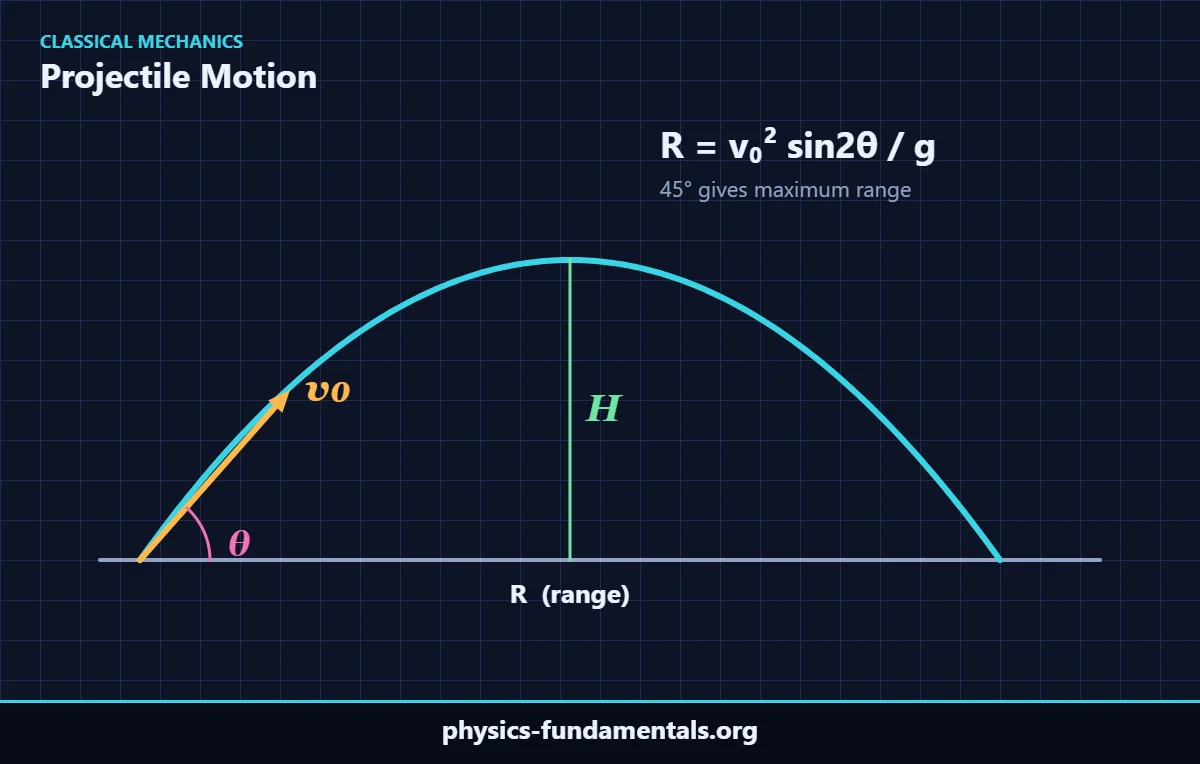
Worked example: a ball launched at an angle
Question: A ball is launched at 20 m/s at 30° above the horizontal on level ground. Find its time of flight, range and maximum height.
- Split the velocity: horizontal uₓ = 20 cos 30° ≈ 17.3 m/s; vertical uᵧ = 20 sin 30° = 10 m/s.
- Time of flight = 2uᵧ ÷ g = 20 ÷ 9.81 ≈ 2.04 s.
- Range = uₓ × t ≈ 17.3 × 2.04 ≈ 35.3 m.
- Maximum height = uᵧ² ÷ 2g = 100 ÷ 19.62 ≈ 5.1 m.
Answer: Time of flight ≈ 2.04 s, range ≈ 35.3 m and maximum height ≈ 5.1 m.
Tip: On level ground, the range formula R = v₀² sin 2θ ÷ g gives the same answer in one step. It also shows that 45° gives the longest range.
Relative Velocity
Velocity always depends on who is measuring it. If two cars travel in the same direction at 25 m/s and 20 m/s, the faster car moves away from the slower one at only 5 m/s. If they travel toward each other, their closing speed is 45 m/s. For motion at an angle, such as a boat crossing a flowing river, you add the velocities as vectors.
Common Kinematics Mistakes
- Using SUVAT when the acceleration is not constant.
- Forgetting to pick a positive direction and sticking to it.
- Mixing up distance and displacement, or speed and velocity.
- Leaving speeds in km/h instead of converting them to m/s.
- Using the total launch speed in vertical projectile equations instead of the vertical component.
Go further: practise with projectile motion MCQs for exam practice with full solutions and read about free fall and terminal velocity explained with examples.
Frequently Asked Questions
What is kinematics in physics?
Kinematics is the branch of mechanics that describes motion using displacement, velocity, acceleration and time, without considering the forces that cause it.
What are the SUVAT equations?
They are five equations for motion with constant acceleration: v = u + at, s = ut + ½at², s = vt − ½at², v² = u² + 2as and s = ½(u + v)t. S is displacement, U is initial velocity, V is final velocity, A is acceleration and T is time.
What is the difference between kinematics and dynamics?
Kinematics describes how an object moves. Dynamics explains why it moves by looking at the forces acting on it.
Can velocity be negative?
Yes. Velocity is a vector, so a negative sign simply means the object is moving in the direction you chose as negative.
Why do heavy and light objects fall at the same rate?
Gravity pulls harder on a heavier object, but that object also has more inertia. The two effects cancel, so without air resistance every object falls with the same acceleration, g.

