SUVAT Equations: The 5 Equations of Motion Explained With Examples
Quick answer
The SUVAT equations are five equations that describe motion with constant acceleration. They link displacement (s), initial velocity (u), final velocity (v), acceleration (a) and time (t). If you know any three of these quantities, you can always find the other two.
Key takeaways
- SUVAT stands for s, u, v, a and t.
- The equations only work when acceleration is constant.
- Each equation leaves out one variable, so pick the one without the quantity you do not know and do not need.
- Choose a positive direction at the start and keep it; quantities in the opposite direction are negative.
- For free fall near Earth, a = 9.81 m/s² downward.
In this guide
- What Do the Letters in SUVAT Mean?
- The Five SUVAT Equations
- How to Choose the Right SUVAT Equation
- Where Do the SUVAT Equations Come From?
- Worked Examples
- Using SUVAT for Vertical Motion
- SUVAT in Two Dimensions
- Common SUVAT Mistakes
- SUVAT Quick Reference: Which Equation for Which Question?
- Frequently asked questions
If you are studying mechanics, the SUVAT equations will appear in almost every motion question you meet. They are short, they are powerful and, once you have a reliable method, they are easy to use. Most mistakes come not from the equations themselves but from choosing the wrong one or mixing up signs.
This guide explains each variable, lists all five equations, shows where they come from and gives a simple step-by-step method for choosing the right equation. You will also find four fully worked examples, a list of common mistakes and a free SUVAT calculator to check your answers.
What Do the Letters in SUVAT Mean?
| Letter | Quantity | SI unit | Notes |
|---|---|---|---|
| s | Displacement | metre (m) | Distance in a straight line, with direction |
| u | Initial velocity | metre per second (m/s) | Velocity at the start of the time period |
| v | Final velocity | metre per second (m/s) | Velocity at the end of the time period |
| a | Acceleration | metre per second squared (m/s²) | Must stay constant for SUVAT to work |
| t | Time | second (s) | Length of the time period |
Four of these five are vectors: s, u, v and a all have a direction. Only time is a scalar. This is why the sign you give each value matters so much.
Tip: “Starts from rest” means u = 0. “Comes to rest” or “stops” means v = 0. “Dropped” means u = 0 and a = g. These phrases often give you one of your three known values.
The Five SUVAT Equations
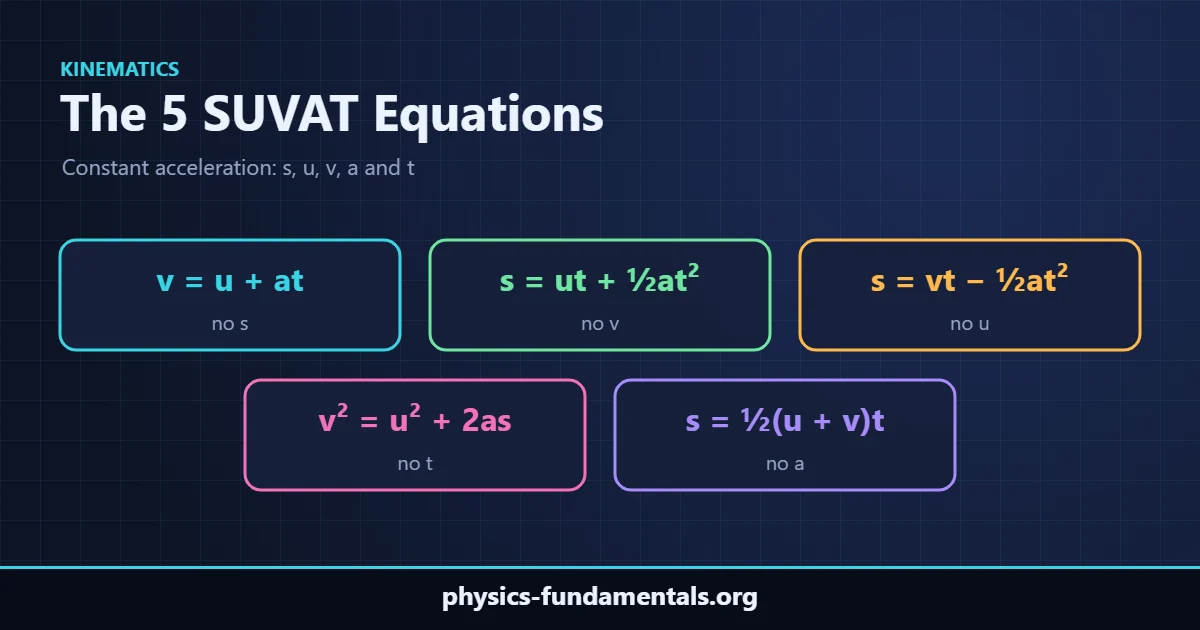
Here are all five equations. Each one contains four of the five variables, and the right-hand column shows which variable it leaves out.
| Equation | Variable it does not contain |
|---|---|
| v = u + at | s |
| s = ut + ½at² | v |
| s = vt − ½at² | u |
| v² = u² + 2as | t |
| s = ½(u + v)t | a |
Some textbooks list only four equations and leave out s = vt − ½at². You can always reach the same answer using the other four, but knowing the fifth often saves a step.
How to Choose the Right SUVAT Equation
Use this five-step method every time. It turns choosing an equation into a simple process instead of a guess.
- Draw a quick sketch and choose which direction is positive.
- Write S, U, V, A, T in a column down the side of your page.
- Fill in the three values you know, with signs and units.
- Put a question mark next to the value you need to find, and cross out the one you neither know nor need.
- Use the equation that does not contain the crossed-out variable, then rearrange and substitute.
For example, if you know u, a and s and you need v, then time is the variable you do not need. The equation without t is v² = u² + 2as, so that is the one to use.
Try it yourself: SUVAT calculator — enter any three values and it finds the other two with full working.
Where Do the SUVAT Equations Come From?
You do not have to memorise the derivations for most exams, but seeing them makes the equations easier to remember and trust.
Equation 1 from the definition of acceleration
Acceleration is the change in velocity divided by time: a = (v − u) ÷ t. Multiply both sides by t and rearrange to get v = u + at.
Equation 5 from average velocity
When acceleration is constant, the average velocity is halfway between u and v, so it equals ½(u + v). Displacement is average velocity × time, which gives s = ½(u + v)t.
The other three by substitution
Replace v in equation 5 with u + at and you get s = ut + ½at². Replace u instead with v − at and you get s = vt − ½at². Finally, take t = (v − u) ÷ a from equation 1, put it into equation 5 and simplify to get v² = u² + 2as.
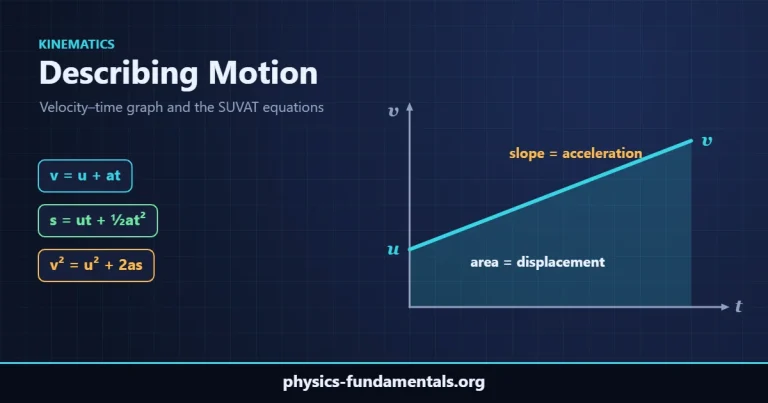
The same results come from a velocity–time graph. The gradient of the straight line is a, and the area under it is s. You can see this graph in our kinematics guide.
Worked Examples
Worked example: a car accelerating from rest
Question: A car starts from rest and accelerates uniformly at 2.5 m/s² for 8 s. How far does it travel, and what is its final speed?
- S = ?, U = 0, V = ?, A = 2.5, T = 8.
- v = u + at = 0 + 2.5 × 8 = 20 m/s.
- s = ut + ½at² = 0 + ½ × 2.5 × 8² = 80 m.
Answer: The car travels 80 m and reaches 20 m/s.
Worked example: an emergency stop
Question: A cyclist travelling at 9 m/s brakes and stops in 12 m. What is the deceleration?
- S = 12, U = 9, V = 0, A = ?, T is not needed.
- Use v² = u² + 2as: 0 = 9² + 2 × a × 12.
- 24a = −81, so a = −3.375 m/s².
Answer: The acceleration is −3.4 m/s² (to 2 s.f.), meaning a deceleration of 3.4 m/s².
Worked example: a ball thrown straight up
Question: A ball is thrown vertically upward at 15 m/s. How high does it go? Take up as positive and g = 9.81 m/s².
- U = 15, V = 0 at the top, A = −9.81, S = ?
- Use v² = u² + 2as: 0 = 15² + 2 × (−9.81) × s.
- 19.62s = 225, so s ≈ 11.5 m.
Answer: The ball rises about 11.5 m before it starts to fall.
Worked example: finding time with a quadratic
Question: A stone is thrown down a well at 4 m/s and hits the water 30 m below. How long does it take? Take down as positive.
- S = 30, U = 4, A = 9.81, T = ?
- s = ut + ½at² gives 30 = 4t + 4.905t².
- Rearrange: 4.905t² + 4t − 30 = 0. Using the quadratic formula, t = (−4 + √(16 + 588.6)) ÷ 9.81.
Answer: t ≈ 2.1 s. Ignore the negative root, because time cannot be negative here.
Using SUVAT for Vertical Motion
Free fall and vertical throws are among the most common SUVAT questions. The acceleration is always g = 9.81 m/s² downward, whether the object is going up, coming down or momentarily stopped at the top.
- If you take up as positive, then a = −9.81 m/s².
- If you take down as positive, then a = +9.81 m/s².
- At the highest point, the velocity is zero but the acceleration is still 9.81 m/s² downward.
- The time to rise equals the time to fall back to the same height, if air resistance is ignored.
Common mistake: Writing a = 0 at the top of a throw. The object stops for an instant, but gravity is still pulling it, so a = g at every moment.
SUVAT in Two Dimensions
For a projectile, use SUVAT twice: once horizontally and once vertically. Horizontally the acceleration is zero (ignoring air resistance), so s = ut. Vertically the acceleration is g. Time is the link between the two directions. Our article on projectile motion works through this in detail.
Common SUVAT Mistakes
- Using SUVAT when acceleration changes, such as when air resistance is significant or a rocket burns fuel.
- Forgetting to give negative values to quantities in the negative direction.
- Mixing units, such as km/h with m/s or minutes with seconds.
- Confusing displacement with total distance travelled when the object turns around.
- Taking the wrong root of a quadratic for time.
A quick check helps: after you finish, put your answer back into a different SUVAT equation. If both equations agree, your answer is almost certainly right.
SUVAT Quick Reference: Which Equation for Which Question?
Exam questions tend to follow a few familiar patterns. The table below matches common wording to the equation you will usually need.
| The question asks… | You usually know | Use |
|---|---|---|
| “How fast is it going after t seconds?” | u, a, t | v = u + at |
| “How far does it travel in t seconds?” | u, a, t | s = ut + ½at² |
| “What is its stopping distance?” | u, v = 0, a | v² = u² + 2as |
| “How long does it take to stop?” | u, v = 0, a | v = u + at |
| “What was its average speed?” with u and v given | u, v, t | s = ½(u + v)t |
| “How high does it go?” | u, v = 0, a = −g | v² = u² + 2as |
Notice how often v² = u² + 2as appears. It is the go-to equation whenever time is not mentioned, which makes it especially useful for braking distances and maximum heights.
Tip: If a question has two stages, such as a car that accelerates and then brakes, the final velocity of stage one becomes the initial velocity of stage two. Solve each stage with its own SUVAT list.
Practise this topic: try these SUVAT equations MCQs with step-by-step solutions and read about free fall and terminal velocity explained with examples.
Frequently Asked Questions
What are the 5 SUVAT equations?
They are v = u + at, s = ut + ½at², s = vt − ½at², v² = u² + 2as and s = ½(u + v)t.
When can you not use SUVAT equations?
You cannot use them when the acceleration changes over time, for example when air resistance grows with speed or when a force varies. In those cases you need calculus or must split the motion into stages.
What is the difference between s and distance in SUVAT?
In SUVAT, s is displacement: the straight-line change in position with a direction. If an object goes up 5 m and comes back down, s = 0 even though it travelled 10 m.
How do I remember the SUVAT equations?
Learn v = u + at and s = ½(u + v)t from their meanings, then practise substituting one into the other to produce the remaining three. Regular practice makes them stick quickly.
Is g positive or negative in SUVAT?
It depends on your sign convention. If you choose up as positive, g = −9.81 m/s². If you choose down as positive, g = +9.81 m/s².