
Electromagnetism Explained: Charge, Current, Circuits and Magnetic Fields
Quick answer
Electromagnetism is the branch of physics that studies electric charges, electric currents and magnetic fields, and how they are connected. A moving charge creates a magnetic field, and a changing magnetic field creates a voltage. These two links power every motor, generator and electronic device.
Key takeaways
- Like charges repel and unlike charges attract; the force follows Coulomb’s law, F = kq₁q₂ ÷ r².
- Current is the flow of charge: I = Q ÷ t, measured in amperes.
- Ohm’s law, V = IR, links voltage, current and resistance.
- Resistors in series add directly; in parallel, their reciprocals add.
- A changing magnetic field induces a voltage (Faraday’s law), which is how generators and transformers work.
Switch on a light, charge your phone or start a car and you are relying on electromagnetism. It is the force that holds atoms together, makes magnets stick and carries signals through every wire and circuit board.
This guide builds the topic step by step. We start with electric charge and the forces between charges, move on to current, voltage and circuits, and finish with magnetic fields and electromagnetic induction. Every section has the key formula and a simple worked example.
What Is Electromagnetism?
Electromagnetism is one of the four fundamental forces of nature, together with gravity and the strong and weak nuclear forces. For a long time, electricity and magnetism were thought to be separate. In the 1800s, Hans Christian Ørsted, Michael Faraday and James Clerk Maxwell showed that they are two sides of the same force.
Maxwell’s equations also predicted that a changing electric field and a changing magnetic field can travel together through space as a wave. These are electromagnetic waves, and light is one of them. You can read more about them in our guide to waves and optics.
Electric Charge and Coulomb’s Law
Electric charge is a property of particles. Protons carry positive charge and electrons carry negative charge. The charge on one electron is −1.6 × 10⁻¹⁹ coulombs (C). Objects become charged when electrons are added or removed, for example by rubbing a balloon on your hair.
- Like charges repel each other.
- Opposite charges attract each other.
- Charge is conserved: it can move, but it cannot be created or destroyed.
- Conductors (such as copper) let charge move easily; insulators (such as rubber) do not.
F = k q₁ q₂ ÷ r²
F is the force in newtons, q₁ and q₂ are the charges in coulombs, r is the distance between them in metres and k ≈ 8.99 × 10⁹ N·m²/C².
Worked example: force between two charges
Question: Two charges of +2 µC each are 0.30 m apart. What is the force between them?
- Convert: 2 µC = 2 × 10⁻⁶ C.
- F = 8.99 × 10⁹ × (2 × 10⁻⁶)² ÷ 0.30².
- F = 8.99 × 10⁹ × 4 × 10⁻¹² ÷ 0.09 ≈ 0.40 N.
Answer: About 0.40 N, and it is repulsive because both charges are positive.
An electric field is the region around a charge where other charges feel a force. Its strength is E = F ÷ q, measured in N/C (or V/m).
Current, Voltage and Resistance
| Quantity | Meaning | Formula | Unit |
|---|---|---|---|
| Current (I) | Rate of flow of charge | I = Q ÷ t | ampere (A) |
| Potential difference (V) | Energy transferred per unit charge | V = W ÷ Q | volt (V) |
| Resistance (R) | How much a component opposes current | R = V ÷ I | ohm (Ω) |
| Power (P) | Rate of energy transfer | P = IV | watt (W) |
Worked example: charge flow
Question: A current of 3 A flows through a lamp for 2 minutes. How much charge passes through it?
- Convert time: 2 minutes = 120 s.
- Q = It = 3 × 120.
- Q = 360 C.
Answer: 360 coulombs of charge flow through the lamp.
Tip: A helpful picture: voltage is like the push from a water pump, current is like the flow of water, and resistance is like a narrow pipe that slows the flow.
Ohm’s Law
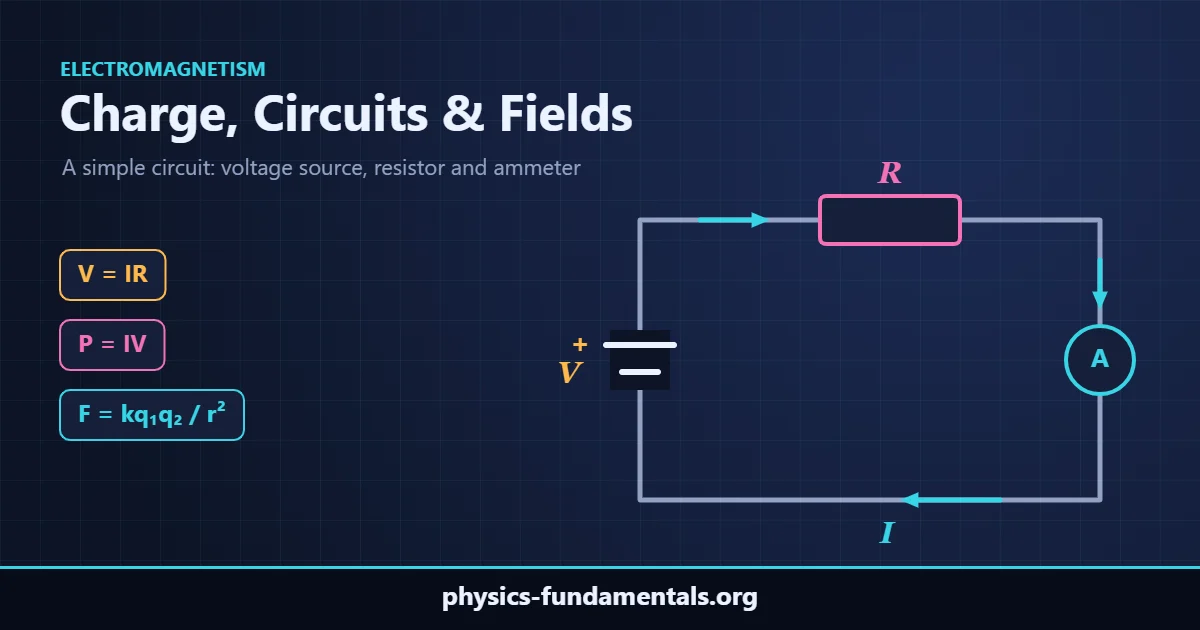
V = IR
For an ohmic conductor at constant temperature, current is directly proportional to voltage. Read our full Ohm’s law guide for I–V graphs and more examples. Double the voltage and the current doubles.
Worked example: using Ohm’s law
Question: A 12 V battery is connected to a 4 Ω resistor. Find the current and the power.
- Current: I = V ÷ R = 12 ÷ 4 = 3 A.
- Power: P = IV = 3 × 12.
- Check with P = I²R = 3² × 4 = 36 W.
Answer: The current is 3 A and the resistor uses 36 W.
Not every component obeys Ohm’s law. A filament lamp gets hotter as current rises, so its resistance increases. A diode only lets current flow easily in one direction. The resistance of most metals also rises with temperature.
Series and Parallel Circuits
| Feature | Series circuit | Parallel circuit |
|---|---|---|
| Current | Same through every component | Splits between branches |
| Voltage | Shared between components | Same across each branch |
| Total resistance | R = R₁ + R₂ + … | 1/R = 1/R₁ + 1/R₂ + … |
| If one lamp breaks | All lamps go out | Other lamps stay on |
| Typical use | Simple strings of decorative lights | Household wiring |
Worked example: resistors in parallel
Question: A 6 Ω and a 3 Ω resistor are connected in parallel. What is the total resistance?
- 1/R = 1/6 + 1/3.
- 1/R = 1/6 + 2/6 = 3/6 = 1/2.
- R = 2 Ω.
Answer: The total resistance is 2 Ω, which is less than the smallest single resistor, as expected for a parallel circuit.
Kirchhoff’s laws handle more complex circuits. The current law says the total current into a junction equals the total current out. The voltage law says the sum of voltages around any closed loop is zero. Both are really conservation of charge and conservation of energy.
A capacitor stores charge on two plates separated by an insulator. Its capacitance is C = Q ÷ V, measured in farads (F). Capacitors smooth power supplies and make camera flashes work.
Magnetic Fields and Forces
A magnet has a north and a south pole. Like poles repel and unlike poles attract. The space around a magnet where magnetic forces act is its magnetic field, measured in tesla (T). Field lines go from north to south outside the magnet.
A current-carrying wire also makes a magnetic field, in circles around the wire. The right-hand grip rule gives its direction: point your right thumb along the current and your fingers curl the way the field goes. Wrapping wire into a coil, called a solenoid, makes a strong, uniform field. Adding an iron core turns it into an electromagnet.
F = BIL and F = qvB
The first gives the force on a wire of length L carrying current I at right angles to a field B. The second gives the force on a charge q moving at speed v across the field. This force is what turns an electric motor.
Tip: Use Fleming’s left-hand rule for motors: First finger = Field, seCond finger = Current, thuMb = Motion.
Electromagnetic Induction
In 1831, Michael Faraday discovered that moving a magnet near a coil of wire produces a voltage. This is electromagnetic induction. The faster the magnetic field changes, the bigger the induced voltage.
- Faraday’s law: the induced voltage equals the rate of change of magnetic flux linkage.
- Lenz’s law: the induced current always flows in a direction that opposes the change that caused it. This is conservation of energy at work.
Generators spin coils inside magnetic fields to make electricity. Transformers use induction to change the size of an alternating voltage.
Vp ÷ Vs = Np ÷ Ns
V is voltage and N is the number of turns on the primary (p) and secondary (s) coils of an ideal transformer.
Worked example: a step-down transformer
Question: A transformer has 1,000 turns on its primary coil and 50 turns on its secondary. The primary voltage is 230 V. What is the secondary voltage?
- Vs = Vp × Ns ÷ Np.
- Vs = 230 × 50 ÷ 1,000.
- Vs = 11.5 V.
Answer: The output is 11.5 V, which suits a low-voltage device.
Common Electromagnetism Mistakes
- Forgetting to convert µC, mA or kΩ into C, A and Ω.
- Adding parallel resistances directly instead of adding their reciprocals.
- Thinking current gets “used up” in a series circuit. It is the same everywhere in the loop.
- Using r instead of r² in Coulomb’s law.
- Forgetting that transformers only work with alternating current.
Go further: study Coulomb’s law with formula, units and solved numericals and practise with electromagnetic spectrum MCQs with answers and explanations.
Frequently Asked Questions
What is electromagnetism in simple words?
Electromagnetism is the force between electric charges. When charges are still, they create electric fields; when they move, they also create magnetic fields. Electricity and magnetism are two parts of the same force.
What is Ohm’s law?
Ohm’s law states that the voltage across a conductor equals the current through it multiplied by its resistance, V = IR, as long as the temperature stays constant.
What is the difference between series and parallel circuits?
In a series circuit, components are in one loop, so the same current flows through all of them and the voltage is shared. In a parallel circuit, each component has its own branch, so they all get the full voltage and the current splits.
How does a generator produce electricity?
A generator rotates a coil of wire inside a magnetic field (or rotates a magnet inside a coil). The changing magnetic field induces a voltage in the coil, as described by Faraday’s law.
Who discovered electromagnetism?
Hans Christian Ørsted showed in 1820 that an electric current affects a compass needle. Michael Faraday discovered induction in 1831, and James Clerk Maxwell combined the ideas into one theory in the 1860s.
