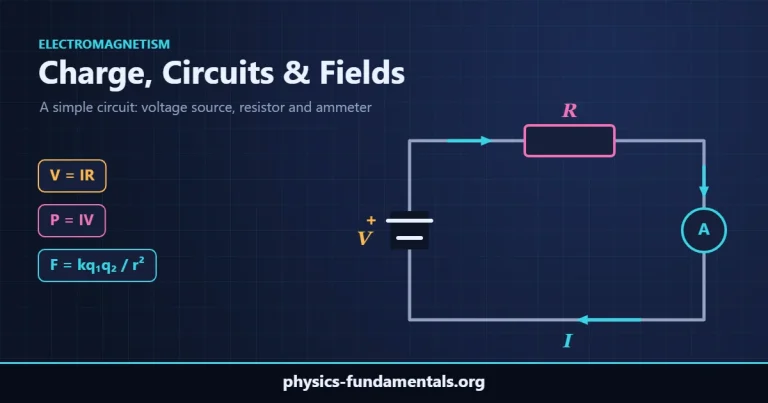
Ohm’s Law Explained: V = IR, Formula, Triangle and Examples
Quick answer
Ohm’s law states that the current through a conductor is directly proportional to the voltage across it, as long as its temperature stays constant. The constant of proportionality is the resistance, giving the formula V = IR, where V is voltage in volts, I is current in amperes and R is resistance in ohms.
Key takeaways
- V = IR links voltage (V), current (A) and resistance (Ω).
- Rearranged: I = V ÷ R and R = V ÷ I.
- Electrical power is P = VI, which also gives P = I²R and P = V² ÷ R.
- An ohmic conductor has a straight-line I–V graph through the origin.
- Filament lamps, diodes and thermistors do not obey this law.
In this guide
- What Is Ohm’s Law?
- The VIR Triangle
- Worked Examples: Finding V, I and R
- Voltage, Current and Electrical Power
- I–V Graphs: Ohmic and Non-Ohmic Components
- Series and Parallel Circuits
- What Affects Resistance?
- Common Mistakes With V = IR
- How to Measure Voltage, Current and Resistance
- V = IR in Everyday Devices
- Frequently asked questions
Every electrical device, from a phone charger to an electric kettle, is designed using one simple relationship: This law. It tells you how much current will flow when a voltage pushes charge through a resistance, and it is the first thing you reach for when analysing any circuit.
This guide explains this law in plain language, shows how to use the Ohm’s law triangle, connects it to electrical power, and explains when the law works and when it does not. Along the way you will find worked examples and a free Ohm’s law calculator to check your answers.
What Is Ohm’s Law?
In 1827 the German physicist Georg Simon Ohm discovered that, for many materials, doubling the voltage across a wire doubles the current through it. The ratio of voltage to current stays constant, and we call that constant the resistance.
V = IR
V is the potential difference (voltage) in volts, I is the current in amperes (amps) and R is the resistance in ohms (Ω).
| Quantity | Symbol | Unit | Meaning |
|---|---|---|---|
| Voltage (potential difference) | V | volt (V) | Energy given to each coulomb of charge |
| Current | I | ampere (A) | Rate of flow of charge |
| Resistance | R | ohm (Ω) | How strongly a component opposes current |
Tip: Think of water in a pipe. Voltage is like the pressure from the pump, current is like the flow of water, and resistance is like a narrow section of pipe that limits the flow.
The VIR Triangle
The triangle is a quick memory aid for rearranging V = IR. Put V at the top and I and R side by side at the bottom. Cover the quantity you want, and what is left shows how to calculate it.
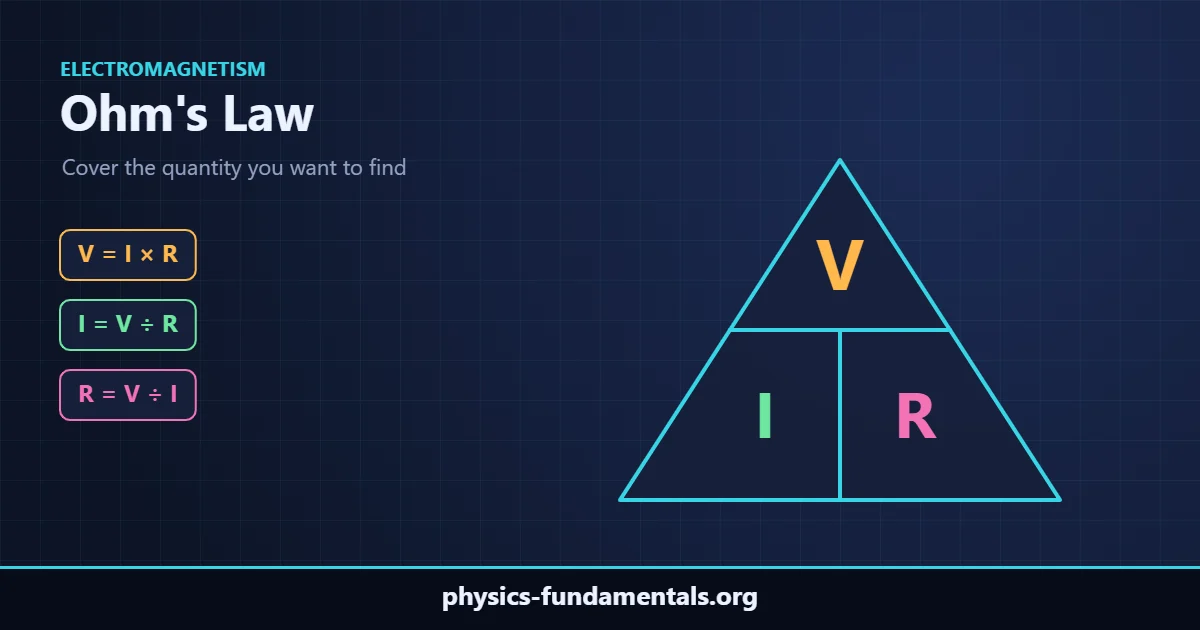
- Cover V: I and R are side by side, so V = I × R.
- Cover I: V is over R, so I = V ÷ R.
- Cover R: V is over I, so R = V ÷ I.
Try it yourself: Ohm’s law calculator — enter any two values to find the third, plus the power.
Worked Examples: Finding V, I and R
Worked example: finding current
Question: A 9 V battery is connected to a 300 Ω resistor. What current flows?
- Use I = V ÷ R.
- I = 9 ÷ 300.
- I = 0.03 A.
Answer: The current is 0.03 A, or 30 mA.
Worked example: finding resistance
Question: A current of 0.5 A flows through a lamp when the voltage across it is 6 V. What is its resistance?
- Use R = V ÷ I.
- R = 6 ÷ 0.5.
- R = 12 Ω.
Answer: The lamp has a resistance of 12 Ω at that current.
Worked example: finding voltage
Question: A current of 2 mA flows through a 4.7 kΩ resistor. What is the voltage across it?
- Convert units: 2 mA = 0.002 A and 4.7 kΩ = 4,700 Ω.
- V = IR = 0.002 × 4,700.
- V = 9.4 V.
Answer: The voltage across the resistor is 9.4 V.
Voltage, Current and Electrical Power
Power tells you how quickly a component transfers energy. Combining P = VI with this law gives two more useful forms.
| Formula | Use it when you know |
|---|---|
| P = VI | Voltage and current |
| P = I²R | Current and resistance |
| P = V² ÷ R | Voltage and resistance |
Worked example: an electric heater
Question: A heater has a resistance of 23 Ω and is connected to a 230 V supply. What is its power?
- Use P = V² ÷ R.
- P = 230² ÷ 23 = 52,900 ÷ 23.
- P = 2,300 W.
Answer: The heater has a power of 2,300 W, or 2.3 kW.
P = I²R explains why power lines carry electricity at very high voltages. For the same power, a higher voltage means a smaller current, and because heating losses depend on I², a smaller current wastes far less energy.
I–V Graphs: Ohmic and Non-Ohmic Components
An I–V graph plots current against voltage for a component. It shows at a glance whether the component obeys this law.
| Component | Shape of I–V graph | Obeys this law? |
|---|---|---|
| Fixed resistor at constant temperature | Straight line through the origin | Yes |
| Filament lamp | S-shaped curve that flattens at high voltage | No: resistance rises as the filament heats up |
| Diode | Almost no current in reverse; current rises sharply above about 0.6 V forwards | No |
| Thermistor | Resistance falls as temperature rises | No |
| LDR (light-dependent resistor) | Resistance falls as light gets brighter | No |
Common mistake: Saying a component with a curved I–V graph has “no resistance”. It still has a resistance at each point (R = V ÷ I); the resistance just changes as the voltage changes.
Series and Parallel Circuits
This law applies to every component and to the circuit as a whole. In a series circuit the same current flows through every component and the total resistance is R = R₁ + R₂ + … . In a parallel circuit every branch gets the full voltage, and the total resistance comes from 1/R = 1/R₁ + 1/R₂ + … .
Worked example: two resistors in series
Question: A 6 Ω and a 4 Ω resistor are connected in series to a 12 V battery. Find the current and the voltage across each resistor.
- Total resistance: 6 + 4 = 10 Ω.
- Current: I = V ÷ R = 12 ÷ 10 = 1.2 A.
- Voltages: V₁ = 1.2 × 6 = 7.2 V and V₂ = 1.2 × 4 = 4.8 V.
Answer: A current of 1.2 A flows, with 7.2 V across the 6 Ω resistor and 4.8 V across the 4 Ω resistor. The two voltages add up to 12 V, as they should.
Our electromagnetism guide covers series and parallel circuits and Kirchhoff’s laws in more detail.
What Affects Resistance?
The resistance of a wire depends on what it is made of and its shape. Longer wires have more resistance, thicker wires have less, and materials such as copper resist far less than nichrome. In equation form, R = ρL ÷ A, where ρ is the resistivity of the material, L is the length and A is the cross-sectional area.
For most metals, resistance also rises with temperature, because the vibrating atoms get in the way of the moving electrons more often. That is the main reason this law only holds at constant temperature.
Common Mistakes With V = IR
- Forgetting to convert mA to A or kΩ to Ω before using the formula.
- Using the battery voltage for one component in a series circuit, instead of the voltage across that component.
- Assuming every component is ohmic.
- Mixing up P = I²R and P = V² ÷ R.
- Rounding too early in multi-step problems.
How to Measure Voltage, Current and Resistance
To check this law in a lab, you measure the current through a component and the voltage across it at several settings, then plot an I–V graph.
- An ammeter measures current. It is connected in series, so the same current flows through it and the component. A good ammeter has a very low resistance.
- A voltmeter measures potential difference. It is connected in parallel, across the component. A good voltmeter has a very high resistance, so almost no current flows through it.
- A variable resistor or adjustable power supply lets you change the voltage step by step.
- A multimeter can measure all three quantities, but resistance must only be measured with the component disconnected from any power supply.
Divide each voltage reading by its current reading. If the answers stay the same, the component is ohmic and that constant value is its resistance.
Tip: Switch off between readings so the component does not heat up. A rising temperature changes the resistance and makes an ohmic resistor look non-ohmic.
V = IR in Everyday Devices
- LED circuits: a resistor is placed in series with an LED to limit the current. This law tells you its size: R = (supply voltage − LED voltage) ÷ desired current.
- Phone chargers: they control voltage and current carefully, so the battery charges quickly without overheating.
- Fuses: a fuse is chosen so that a normal current passes safely, but a fault current, found from this law, melts the fuse wire and breaks the circuit.
- Dimmer switches and volume controls: changing a resistance changes the current, which changes the brightness or loudness.
Related reading: learn how charges attract and repel in this Coulomb’s law guide with formula and solved numericals, then test yourself with Coulomb’s law MCQs with answers and explanations.
Frequently Asked Questions
What is Ohm’s law in simple terms?
Ohm’s law says that the current through a conductor equals the voltage across it divided by its resistance, I = V ÷ R. More voltage pushes more current; more resistance lets less current through.
What is the formula for Ohm’s law?
V = IR, where V is voltage in volts, I is current in amperes and R is resistance in ohms. It can be rearranged to I = V ÷ R and R = V ÷ I.
Does every material obey this law?
No. It applies to ohmic conductors, such as metal wires and resistors at constant temperature. Filament lamps, diodes and thermistors are non-ohmic.
What is the unit of resistance?
The ohm, symbol Ω. One ohm is the resistance that lets a current of 1 A flow when the voltage is 1 V.
How are voltage, current and power related?
Power is P = VI. Substituting V = IR gives P = I²R, and substituting I = V ÷ R gives P = V² ÷ R.