Newton’s Second Law of Motion (F = ma) Explained With Examples
Quick answer
Newton’s second law says that the net force on an object equals its mass multiplied by its acceleration: F = ma. A bigger net force produces a bigger acceleration, and a bigger mass produces a smaller acceleration for the same force. The acceleration always points in the same direction as the net force.
Key takeaways
- F = ma uses the net (resultant) force, not any single force.
- Force is measured in newtons: 1 N = 1 kg·m/s².
- If the net force is zero, the acceleration is zero: the object stays still or moves at a constant velocity.
- Weight is a force: W = mg.
- Apply F = ma separately in each direction, such as horizontally and vertically.
In this guide
- What Is Newton’s Second Law?
- How to Find the Net Force
- Weight and F = ma
- Applying F = ma: Lifts, Slopes and Pulleys
- Forces at an Angle
- The Momentum Form of the Second Law
- Common Mistakes With F = ma
- Real-World Examples of Newton’s Second Law
- How the Second Law Fits With Newton’s Other Laws
- Frequently asked questions
Push an empty shopping trolley and it shoots forward. Push a full one just as hard and it barely moves. Newton’s second law explains exactly why, and it turns that everyday experience into an equation you can use to predict motion.
Of Newton’s three laws, the second is the one you will use most in calculations. It links forces, which cause motion, to acceleration, which describes it. This guide explains what the law means, how to find the net force, how to handle weight, slopes, lifts and connected objects, and how to avoid the most common mistakes.
What Is Newton’s Second Law?
The second law states that the acceleration of an object is directly proportional to the net force acting on it and inversely proportional to its mass. In symbols:
Fnet = ma
Fnet is the net force in newtons (N), m is the mass in kilograms (kg) and a is the acceleration in metres per second squared (m/s²).
“Directly proportional” means that doubling the net force doubles the acceleration. “Inversely proportional” means that doubling the mass halves the acceleration. The equation also defines the newton: 1 N is the force that gives a 1 kg mass an acceleration of 1 m/s².
Newton’s first law is really a special case of the second. If Fnet = 0, then a = 0, so the object either stays at rest or keeps moving at a constant velocity.
How to Find the Net Force
Most objects have several forces acting on them at once. The net force is what you get when you add them all together, taking direction into account.
- Draw a free-body diagram showing every force on the object.
- Choose a positive direction, usually the direction of motion.
- Add forces in that direction and subtract forces in the opposite direction.
- If forces act at angles, split them into horizontal and vertical components first.
Worked example: a crate being pushed
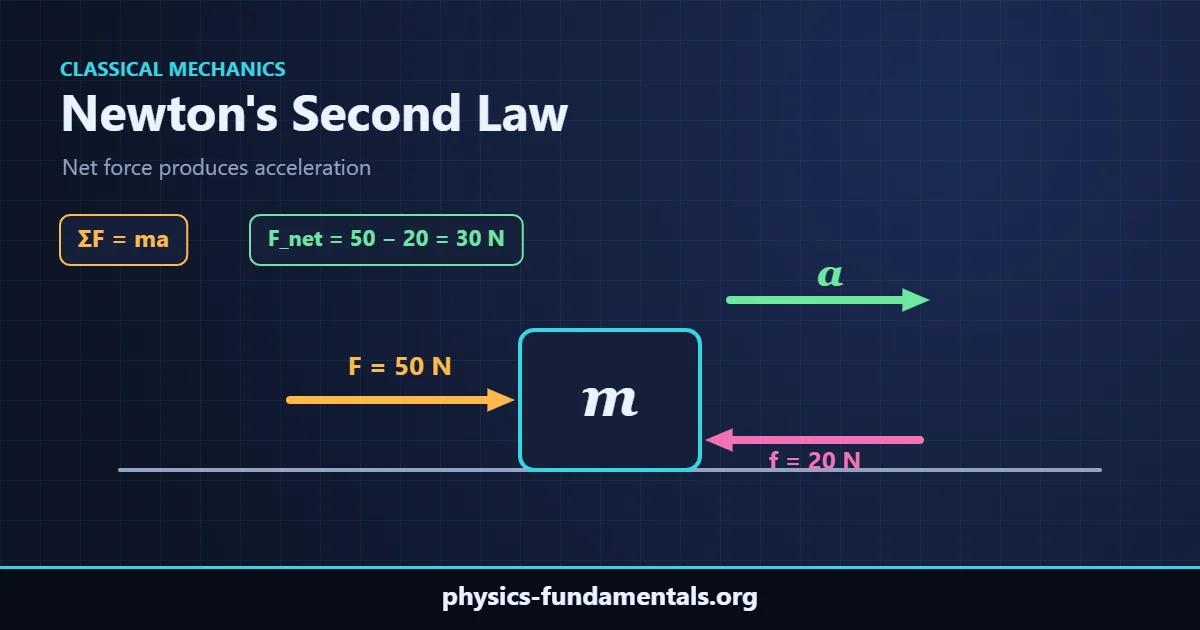
Question: A 15 kg crate is pushed with a force of 50 N while friction of 20 N acts against it. What is its acceleration?
- Net force = 50 − 20 = 30 N in the direction of the push.
- a = Fnet ÷ m = 30 ÷ 15.
- a = 2 m/s².
Answer: The crate accelerates at 2 m/s² in the direction of the push.
Try it yourself: F = ma calculator — find force, mass or acceleration with the working shown.
Weight and F = ma
Weight is the force of gravity on a mass. Because gravity gives every falling object the same acceleration, g, the second law gives the weight directly:
W = mg
W is weight in newtons, m is mass in kg and g ≈ 9.81 m/s² near Earth’s surface (also written as 9.81 N/kg).
A 70 kg person therefore weighs about 70 × 9.81 ≈ 687 N on Earth. On the Moon, where g ≈ 1.62 m/s², the same person weighs only about 113 N, but their mass is still 70 kg.
Common mistake: Writing a weight in kilograms. Kilograms measure mass. When someone says “I weigh 70 kg”, physics would say “my mass is 70 kg and my weight is about 687 N”.
Applying F = ma: Lifts, Slopes and Pulleys
Objects in a lift
When a lift accelerates upward, the floor must push up harder than your weight to give you that acceleration. Taking up as positive: R − mg = ma, so R = m(g + a). This larger normal force is why you feel heavier as a lift starts going up.
Worked example: a lift accelerating upward
Question: A 60 kg person stands in a lift accelerating upward at 1.5 m/s². What force does the floor exert on them?
- Forces: normal force R up, weight mg down.
- The second law: R − mg = ma.
- R = 60 × (9.81 + 1.5) = 60 × 11.31.
Answer: R ≈ 679 N, compared with a weight of about 589 N.
A block sliding down a smooth slope
On a slope of angle θ, the component of weight acting down the slope is mg sin θ. With no friction, that is the only force along the slope, so ma = mg sin θ and a = g sin θ. Notice that the mass cancels out. Add friction and you subtract it: ma = mg sin θ − f.
Two connected objects
For objects joined by a string, such as a trolley pulled by a hanging mass, you can treat the whole system as one object to find the acceleration, then apply F = ma to one object on its own to find the tension in the string.
Worked example: a hanging mass pulling a trolley
Question: A 2 kg trolley on a smooth table is joined by a light string over a pulley to a 0.5 kg hanging mass. Find the acceleration and the tension.
- Driving force on the whole system: weight of the hanging mass = 0.5 × 9.81 = 4.905 N.
- Total mass = 2 + 0.5 = 2.5 kg, so a = 4.905 ÷ 2.5 ≈ 1.96 m/s².
- Tension pulls the trolley, so T = 2 × 1.96 ≈ 3.92 N.
Answer: The system accelerates at about 1.96 m/s² and the tension is about 3.9 N.
Forces at an Angle
When a force acts at an angle θ to the direction of motion, only its component along the motion, F cos θ, causes acceleration in that direction. The other component, F sin θ, acts at right angles and may change the normal force instead.
Worked example: pulling a suitcase
Question: A 20 kg suitcase on smooth wheels is pulled with a force of 60 N at 40° above the horizontal. What is its horizontal acceleration?
- Horizontal component of the pull: 60 × cos 40° ≈ 46.0 N.
- No friction, so the net horizontal force is 46.0 N.
- a = 46.0 ÷ 20.
Answer: a ≈ 2.3 m/s² horizontally.
The Momentum Form of the Second Law
Newton actually wrote his law in terms of momentum: the net force equals the rate of change of momentum, F = Δp ÷ Δt. When mass stays constant, Δp = mΔv, so this becomes F = m(Δv ÷ Δt) = ma.
The momentum form is more general. It works even when the mass changes, as with a rocket burning fuel or a conveyor belt collecting sand, and it leads directly to the idea of impulse explained in our momentum section.
Common Mistakes With F = ma
- Using one force instead of the net force in F = ma.
- Forgetting friction, air resistance or the component of weight on a slope.
- Mixing up mass (kg) and weight (N).
- Treating a constant velocity as needing a constant net force. Constant velocity means zero net force.
- Adding forces at angles as if they all pointed the same way.
Tip: After solving, check the direction of your answer. If the acceleration comes out negative, the object is accelerating in the direction you chose as negative, which may mean it is slowing down.
Real-World Examples of Newton’s Second Law
- Football: a harder kick applies a bigger force for the same short time, so the ball leaves the boot with a bigger acceleration and a higher speed.
- Lorries and cars: a fully loaded lorry needs a much stronger engine force than a small car to reach the same acceleration, because its mass is many times larger.
- Rockets: as fuel burns, the rocket’s mass falls, so the same thrust produces a larger and larger acceleration.
- Seat belts: stopping a passenger needs a force. A seat belt applies that force over a slightly longer time and distance, keeping it small enough to be safe.
- Sprinters: athletes push backwards hard on the starting blocks, and the reaction force from the blocks accelerates them forward.
How the Second Law Fits With Newton’s Other Laws
| Law | What it says | Key idea |
|---|---|---|
| First law | No net force means no change in velocity | Inertia |
| Second law | Net force = mass × acceleration | F = ma |
| Third law | Forces come in equal and opposite pairs on different objects | Action and reaction |
The three laws work together. The first tells you when an object will accelerate, the second tells you by how much, and the third tells you where the forces come from. For example, a swimmer pushes water backwards (third law), the water pushes the swimmer forwards, and the swimmer’s acceleration depends on that forward force minus the drag, divided by their mass (second law).
Practise this topic: work through these Newton’s second law MCQs with worked answers and another explanation of Newton’s second law of motion with solved problems.
Frequently Asked Questions
What is Newton’s second law in simple words?
The harder you push something, the faster it speeds up, and the heavier it is, the more slowly it speeds up. In equation form: net force = mass × acceleration, F = ma.
What is the unit of force in F = ma?
Force is measured in newtons (N). One newton equals one kilogram metre per second squared (kg·m/s²).
What happens when the net force is zero?
The acceleration is zero. The object stays at rest or continues moving at a constant velocity, which is Newton’s first law.
Does F = ma work for objects moving at constant speed?
Yes. At constant velocity, a = 0, so F = ma tells you the net force must be zero: the driving force exactly balances the resistive forces.
Who discovered Newton’s second law?
Isaac Newton published it in 1687 in his book Philosophiæ Naturalis Principia Mathematica, building on earlier work by Galileo.