Classical Mechanics Explained: Forces, Motion, Energy and Momentum
Quick answer
Classical mechanics is the branch of physics that explains how forces make objects move. It is built on Newton’s three laws of motion and uses ideas such as force, mass, acceleration, energy and momentum to predict the motion of everyday objects, from a rolling ball to a planet in orbit.
Key takeaways
- A force is a push or a pull. Forces are vectors, so direction matters.
- Newton’s second law, F = ma, links the net force on an object to its acceleration.
- Work is done when a force moves an object: W = Fd cos θ.
- Energy and momentum are conserved, which makes many problems much easier to solve.
- Classical mechanics works very well for everyday speeds and sizes, but not near the speed of light or at atomic scales.
In this guide
- What Is Classical Mechanics?
- Newton’s Three Laws of Motion
- Types of Forces You Need to Know
- How to Draw a Free-Body Diagram
- Work, Energy and Power
- Momentum and Collisions
- Circular Motion and Gravitation
- Common Mistakes in Classical Mechanics
- Where Classical Mechanics Stops Working
- Frequently asked questions
Every time you push a door, ride a bike or throw a ball, you are using Newtonian mechanics. It is the oldest and most practical part of physics, and almost every physics course begins here. Once you understand it, topics like electricity, waves and even relativity become much easier, because they reuse the same ideas.
This guide explains Newtonian mechanics in plain language. You will learn what forces are, how Newton’s laws work, how to draw a free-body diagram, and how energy and momentum help you solve problems quickly. Each section includes the key formula and a short worked example.
What Is Classical Mechanics?
Classical mechanics studies the motion of objects and the forces that cause that motion. The word “classical” separates it from modern theories such as relativity and quantum mechanics. Isaac Newton set out its main rules in 1687, and engineers still use them every day to design cars, bridges, aircraft and machines.
It has two main parts. Kinematics describes motion using position, velocity and acceleration, without asking what causes it. Dynamics explains motion using forces. On top of these sit two powerful tools: the conservation of energy and the conservation of momentum.
| Quantity | Symbol | SI unit | Scalar or vector |
|---|---|---|---|
| Mass | m | kilogram (kg) | Scalar |
| Displacement | s | metre (m) | Vector |
| Velocity | v | metre per second (m/s) | Vector |
| Acceleration | a | metre per second squared (m/s²) | Vector |
| Force | F | newton (N) | Vector |
| Energy and work | E, W | joule (J) | Scalar |
| Momentum | p | kilogram metre per second (kg·m/s) | Vector |
Newton’s Three Laws of Motion
Newton’s laws are the foundation of Newtonian mechanics. Learn them well, because nearly every mechanics question uses at least one of them.
First law: the law of inertia
An object stays at rest, or keeps moving in a straight line at a constant speed, unless a net force acts on it. This tendency to resist changes in motion is called inertia. A heavier object has more inertia, which is why a loaded trolley is harder to start and stop than an empty one.
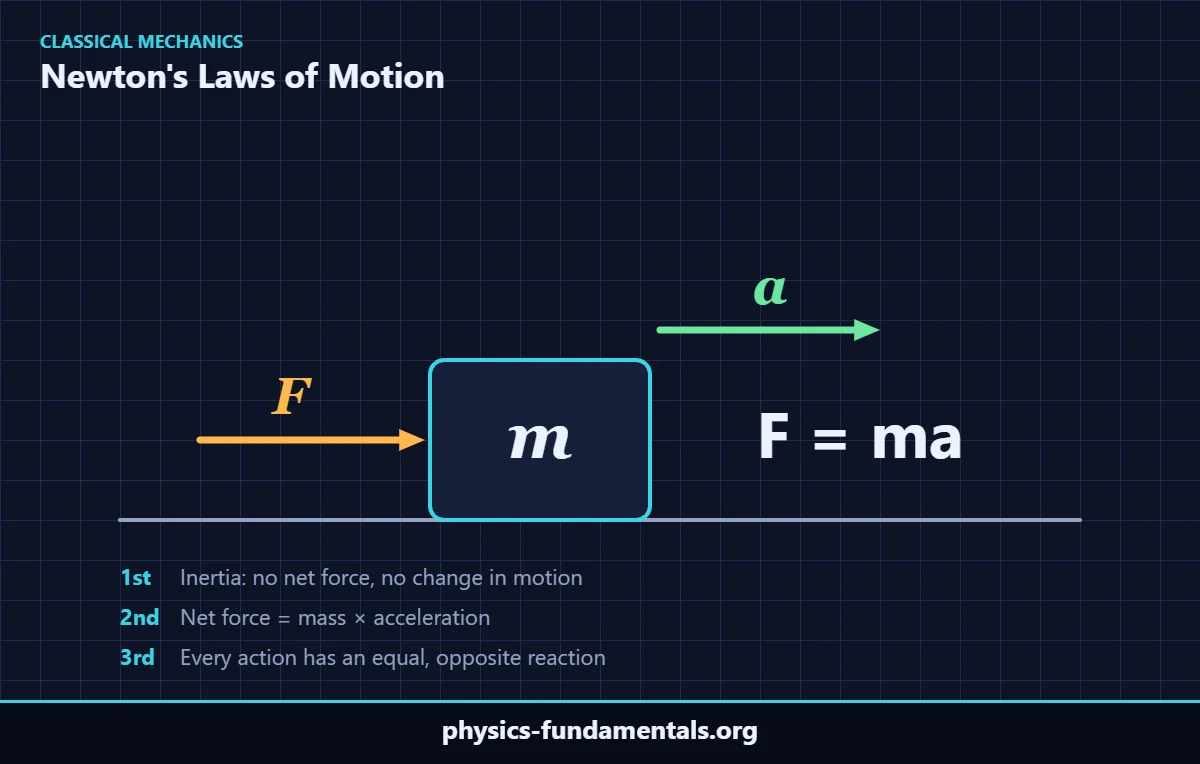
Second law: F = ma
The net force on an object equals its mass multiplied by its acceleration. A bigger force gives a bigger acceleration, and a bigger mass gives a smaller acceleration for the same force.
Fnet = ma
Fnet is the net (resultant) force in newtons, m is mass in kilograms and a is acceleration in m/s². One newton is the force that gives a 1 kg mass an acceleration of 1 m/s².
Third law: action and reaction
When object A pushes on object B, object B pushes back on object A with a force of the same size in the opposite direction. These two forces act on different objects, so they never cancel each other out. When you walk, your foot pushes the ground backward and the ground pushes you forward.
Worked example: finding acceleration
Question: A net force of 30 N acts on a 6 kg box on a smooth floor. What is its acceleration?
- Write the formula: F = ma, so a = F ÷ m.
- Substitute the values: a = 30 ÷ 6.
- Check the units: N ÷ kg = m/s².
Answer: a = 5 m/s² in the direction of the force.
Types of Forces You Need to Know
Most problems use a small set of everyday forces. Recognising them quickly is half the work.
- Weight (W = mg): the pull of gravity on a mass. On Earth, g ≈ 9.81 m/s², so a 10 kg mass weighs about 98 N.
- Normal force (N): the push from a surface, always at right angles to that surface.
- Friction (f): resists sliding between surfaces. For sliding friction, f = μN, where μ is the coefficient of friction.
- Tension (T): the pull in a rope, string or cable.
- Air resistance (drag): opposes motion through air and grows as speed increases.
- Spring force (F = kx): Hooke’s law, where k is the spring constant and x is the extension.
Common mistake: Mass and weight are not the same. Mass (kg) is the amount of matter and never changes. Weight (N) is a force and depends on gravity, so you weigh less on the Moon but your mass stays the same.
How to Draw a Free-Body Diagram
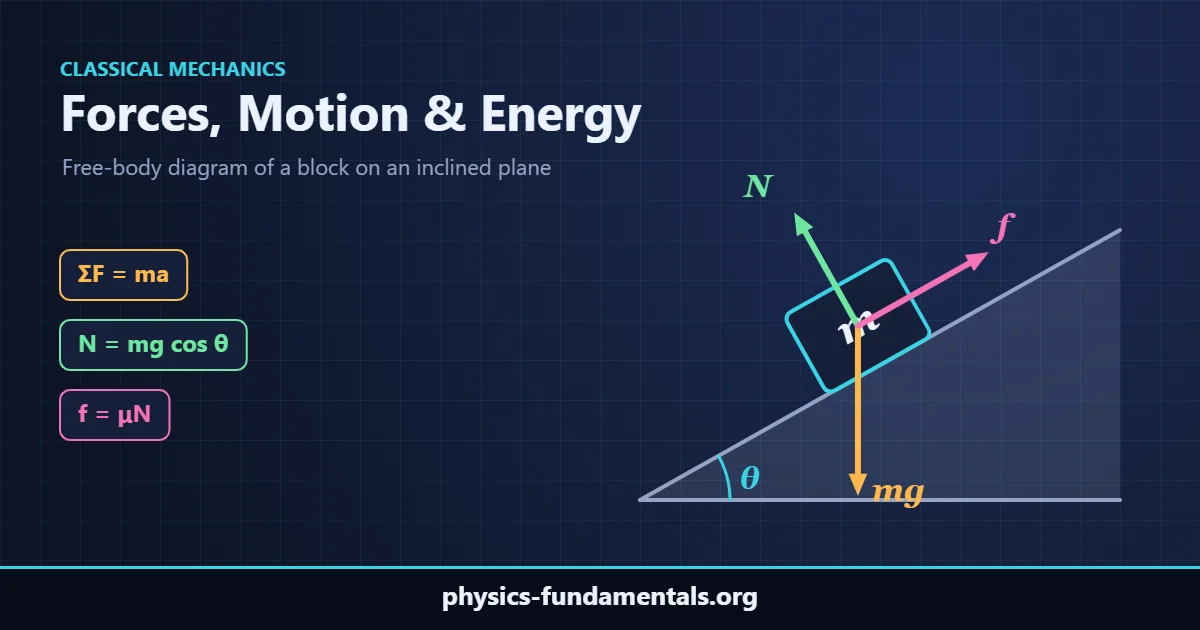
A free-body diagram shows one object and every force acting on it as arrows. It turns a confusing situation into a clear picture, and it is the single most useful habit in mechanics.
- Draw the object as a simple box or dot.
- Add weight (mg) pointing straight down.
- Add the normal force at right angles to any surface the object touches.
- Add friction along the surface, opposite to the motion or attempted motion.
- Add any other pushes, pulls or tensions.
- Choose axes. On a slope, use one axis along the slope and one at right angles to it.
- Apply ΣF = ma separately along each axis.
On a slope of angle θ, split the weight into two parts: mg sin θ down the slope and mg cos θ into the slope. The normal force balances the second part, so N = mg cos θ when nothing else pushes into the surface.
Tip: Only draw forces acting on the object. Forces the object exerts on other things belong on their free-body diagrams, not this one.
Work, Energy and Power
Forces and accelerations are not always the easiest route to an answer. Energy methods often give the result in one or two lines, especially when the path is curved.
Work done by a force
W = F d cos θ
W is work in joules, F is the force, d is the distance moved and θ is the angle between the force and the motion. If the force is at right angles to the motion, it does no work.
Kinetic and potential energy
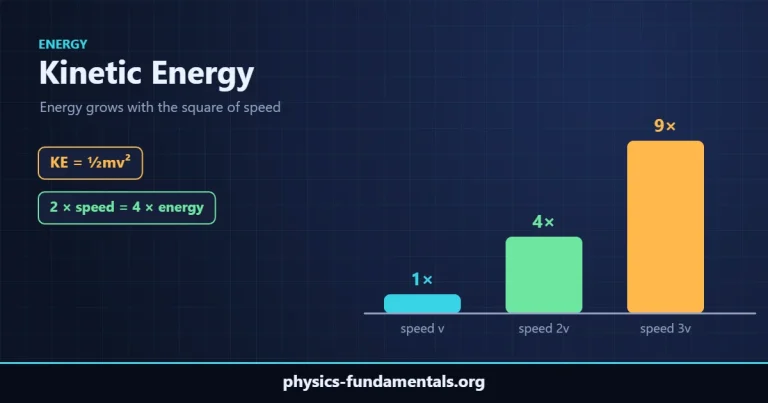
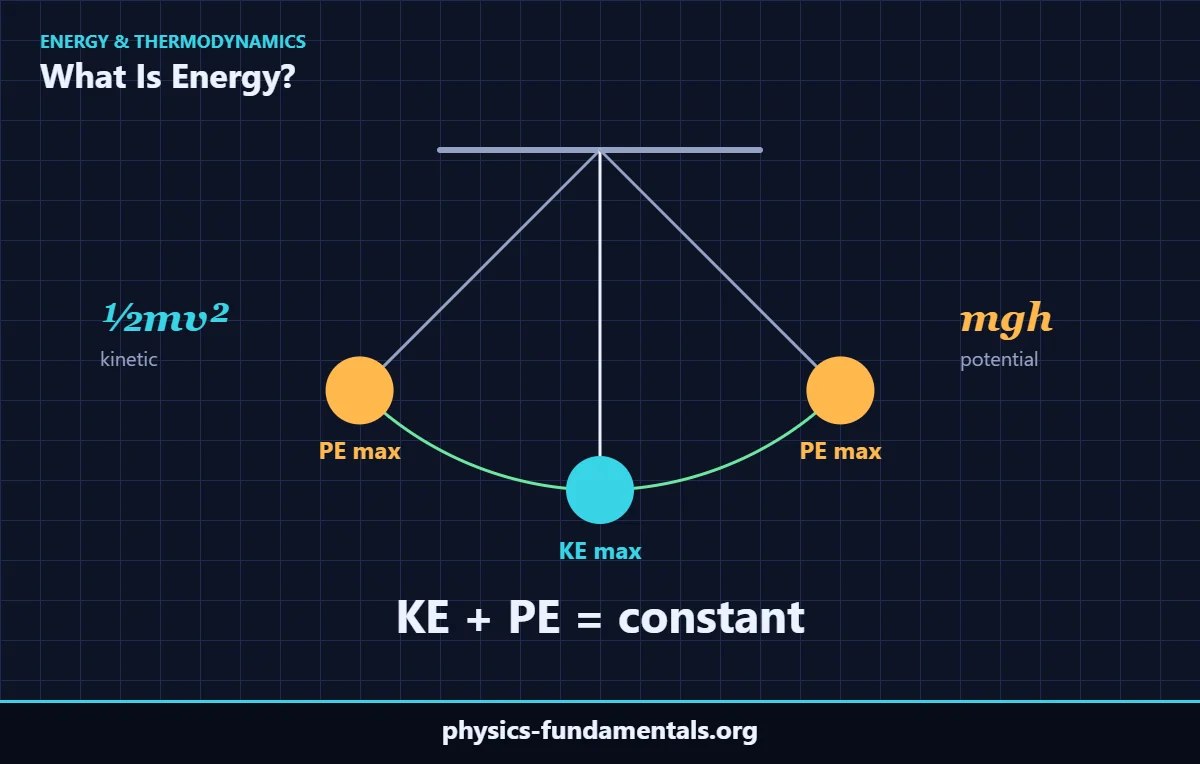
Kinetic energy is energy of motion: KE = ½mv². Gravitational potential energy is energy due to height: GPE = mgh. Elastic potential energy is stored in a stretched spring: ½kx².
The work–energy theorem says that the net work done on an object equals its change in kinetic energy. The conservation of energy says energy is never created or destroyed, only changed from one form to another.
Worked example: energy conservation
Question: A 2 kg ball is dropped from 5 m. Ignoring air resistance, how fast is it moving just before it hits the ground?
- Energy at the top is all potential: GPE = mgh = 2 × 9.81 × 5 = 98.1 J.
- At the bottom it is all kinetic: ½mv² = 98.1 J.
- Solve: v² = 2 × 98.1 ÷ 2 = 98.1, so v = √98.1.
Answer: v ≈ 9.9 m/s. Notice the mass cancels, so every object falls at the same speed without air resistance.
Power
P = W ÷ t = Fv
Power is the rate of doing work, measured in watts (W). One watt is one joule per second. Fv is useful when a force keeps an object moving at speed v.
Momentum and Collisions
Momentum measures how hard it is to stop a moving object. It depends on both mass and velocity.
p = mv
Momentum p is in kg·m/s and has the same direction as the velocity.
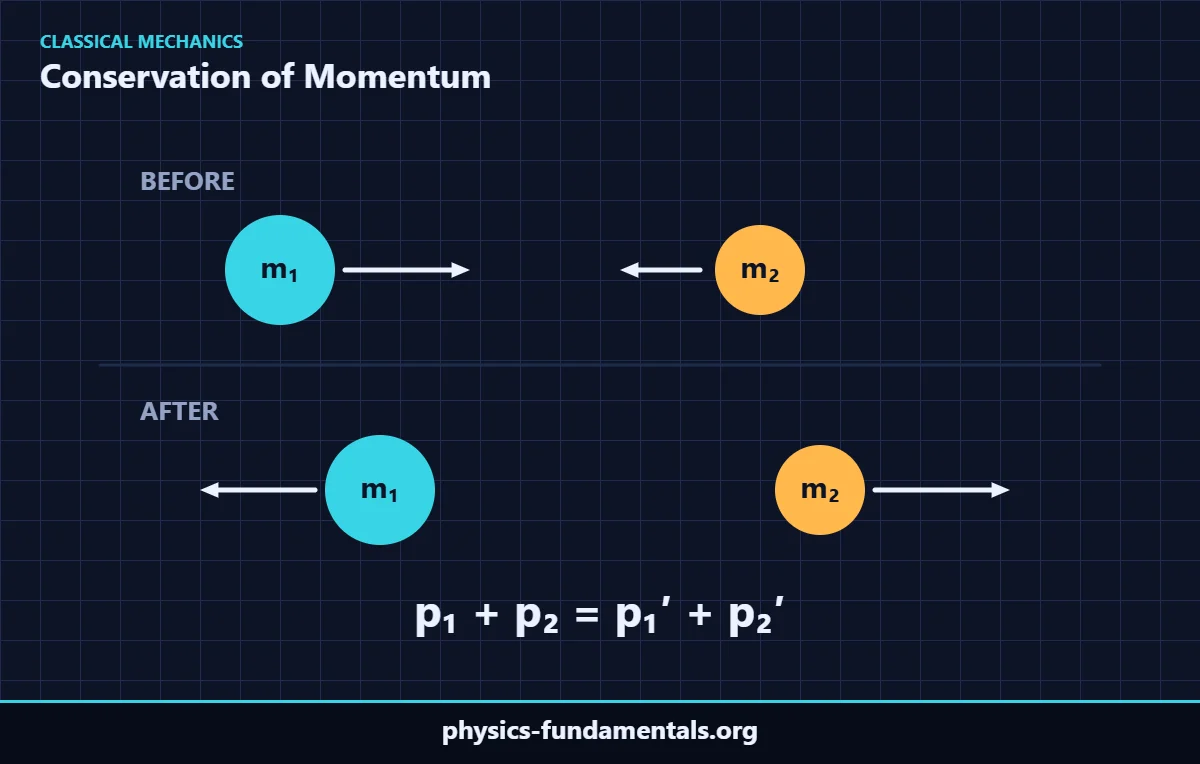
The law of conservation of momentum says that in a closed system with no external force, the total momentum before an event equals the total momentum after it. This works for collisions, explosions and recoil.
| Type of collision | Momentum conserved? | Kinetic energy conserved? | Example |
|---|---|---|---|
| Elastic | Yes | Yes | Snooker balls (very nearly) |
| Inelastic | Yes | No | A car crash |
| Perfectly inelastic | Yes | No (maximum loss) | Objects stick together |
A change in momentum is called impulse: J = FΔt = Δp. This is why airbags and crumple zones work. They make the stopping time longer, so the force on the passenger is smaller.
Worked example: a collision where objects stick together
Question: A 1,000 kg car moving at 12 m/s hits a stationary 1,500 kg car and they move off together. What is their speed?
- Momentum before = 1,000 × 12 + 1,500 × 0 = 12,000 kg·m/s.
- Momentum after = (1,000 + 1,500) × v = 2,500v.
- Set them equal: 2,500v = 12,000.
Answer: v = 4.8 m/s in the original direction.
Circular Motion and Gravitation
An object moving in a circle at constant speed is still accelerating, because its direction keeps changing. This acceleration points toward the centre of the circle and is called centripetal acceleration.
a = v² ÷ r and F = mv² ÷ r
r is the radius of the circle. The centripetal force is not a new kind of force; it is provided by something real, such as tension, friction or gravity.
Newton’s law of universal gravitation describes the attraction between any two masses: F = Gm₁m₂ ÷ r², where G = 6.67 × 10⁻¹¹ N·m²/kg². For a satellite, gravity supplies the centripetal force, which explains why orbits are stable.
Tip: “Centrifugal force” is only felt in a rotating frame of reference. When you solve problems from the ground, use centripetal force only.
Common Mistakes in Classical Mechanics
- Forgetting that forces and velocities are vectors and adding them as plain numbers.
- Using total force instead of net force in F = ma.
- Cancelling third-law pairs, even though they act on different objects.
- Mixing units, such as grams with kilograms or km/h with m/s.
- Assuming no motion means no force. It means no net force.
A good routine avoids most of these errors: draw a diagram, list the known values with units, choose the formula, substitute, and then check whether the answer is sensible.
Where Classical Mechanics Stops Working
Newtonian mechanics is extremely accurate for everyday objects, but it has limits. Near the speed of light you need special relativity, and for atoms and electrons you need quantum mechanics. Even so, both newer theories reduce to Newton’s laws at ordinary speeds and sizes, which is why Newtonian mechanics remains the best place to start.
Frequently Asked Questions
What is classical mechanics in simple words?
Classical mechanics is the part of physics that explains how and why things move. It uses Newton’s laws of motion to connect forces with changes in motion, and it applies to everyday objects moving at normal speeds.
What are the main topics in classical mechanics?
The main topics are kinematics, Newton’s laws of motion, types of forces, work, energy and power, momentum and collisions, circular motion, gravitation and simple harmonic motion.
What is the difference between classical and quantum mechanics?
Classical mechanics describes large objects such as balls, cars and planets. Quantum mechanics describes very small things such as atoms and electrons, where energy comes in packets and particles also behave like waves.
Why is F = ma so important?
F = ma links force, mass and acceleration in one equation. If you know the forces on an object, it tells you how the object will move, which is the central question of mechanics.
Is energy or momentum conserved in a collision?
Momentum is always conserved when no external force acts. Kinetic energy is only conserved in elastic collisions; in inelastic collisions some of it changes into heat, sound or deformation.