Kinetic Energy (KE = ½mv²): Formula, Derivation and Examples
Quick answer
Kinetic energy is the energy an object has because it is moving. It is calculated with KE = ½mv², where m is the mass in kilograms and v is the speed in metres per second, giving an answer in joules. Because speed is squared, doubling an object’s speed makes its kinetic energy four times larger.
Key takeaways
- KE = ½mv², measured in joules (J).
- KE is a scalar and is never negative.
- Doubling the mass doubles KE; doubling the speed quadruples it.
- The net work done on an object equals its change in KE.
- Energy of motion can be converted into other forms, such as potential energy, heat and sound, but the total energy is conserved.
In this guide
- What Is Kinetic Energy?
- The KE = ½mv² Formula
- Worked Examples
- Where Does KE = ½mv² Come From?
- The Work–Energy Theorem
- Kinetic and Potential Energy Together
- KE vs Momentum
- Common Mistakes With KE = ½mv²
- Types of Energy of Motion
- Energy of Motion in Everyday Life
- How to Solve KE Problems
- Frequently asked questions
A rolling bowling ball, a speeding car and the wind turning a turbine all have something in common: they are moving, so they carry KE. That energy can do useful work, like generating electricity, or cause damage, as in a crash.
In this guide you will learn what energy of motion is, how to use the formula KE = ½mv², where the formula comes from, and how KE links to work, potential energy and momentum. Worked examples show each idea in action, and our kinetic energy calculator lets you check your own answers.
What Is Kinetic Energy?
Energy of motion is the energy of motion. Any object with mass that is moving has KE, from a tiny gas molecule to a planet in orbit. When the object is at rest, its energy of motion is zero.
The word “kinetic” comes from the Greek word kinesis, meaning motion. KE is one of the main energy stores in physics, alongside gravitational potential energy, elastic energy, thermal energy and chemical energy.
The KE = ½mv² Formula
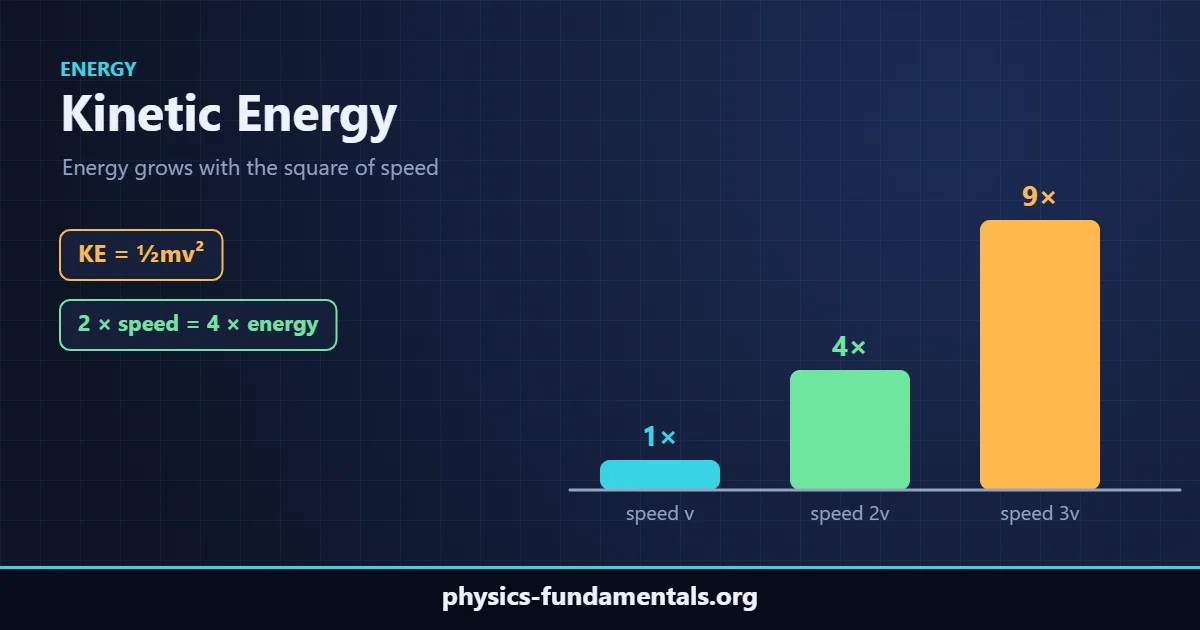
KE = ½mv²
KE is energy of motion in joules (J), m is mass in kilograms (kg) and v is speed in metres per second (m/s). One joule equals one kg·m²/s².
| Change | Effect on energy of motion |
|---|---|
| Double the mass | KE doubles (× 2) |
| Double the speed | KE quadruples (× 4) |
| Triple the speed | KE becomes 9 times larger |
| Halve the speed | KE falls to one quarter |
You can rearrange the formula to find mass or speed: m = 2KE ÷ v² and v = √(2KE ÷ m).
Try it yourself: Kinetic energy calculator — find KE, mass or speed with every step shown.
Worked Examples
Worked example: a running student
Question: A 50 kg student runs at 6 m/s. What is their KE?
- KE = ½mv².
- KE = ½ × 50 × 6² = ½ × 50 × 36.
- KE = 900 J.
Answer: The student has 900 J of KE.
Worked example: a car on a motorway
Question: A 1,200 kg car travels at 31 m/s (about 70 mph). What is its KE?
- KE = ½ × 1,200 × 31².
- KE = 600 × 961.
- KE = 576,600 J.
Answer: About 577 kJ, or 5.8 × 10⁵ J.
Worked example: finding speed from energy
Question: A 0.16 kg cricket ball has 72 J of KE. How fast is it moving?
- v = √(2KE ÷ m).
- v = √(2 × 72 ÷ 0.16) = √900.
- v = 30 m/s.
Answer: The ball is moving at 30 m/s, which is 108 km/h.
Where Does KE = ½mv² Come From?
KE equals the work needed to bring an object from rest up to speed v. Imagine a constant net force F pushing a mass m from rest over a distance s.
- Work done: W = Fs.
- Newton’s second law gives F = ma, so W = mas.
- From the SUVAT equation v² = u² + 2as with u = 0, we get as = ½v².
- Substitute: W = m × ½v² = ½mv².
So the work done to reach speed v is ½mv², and that is exactly the energy of motion the object now carries. You can read more about the equation used here in our guide to the SUVAT equations.
The Work–Energy Theorem
The work–energy theorem states that the net work done on an object equals its change in KE: Wnet = ΔKE = ½mv² − ½mu².
This is often the quickest way to solve problems involving speeding up or slowing down, especially when the force acts over a known distance but the time is not given.
Worked example: braking distance
Question: A 1,000 kg car moving at 20 m/s brakes with a constant force of 8,000 N. How far does it travel before stopping?
- Initial KE = ½ × 1,000 × 20² = 200,000 J. Final KE = 0.
- The brakes must do 200,000 J of work: F × d = 200,000.
- d = 200,000 ÷ 8,000 = 25 m.
Answer: The car stops in 25 m. At 40 m/s it would need 100 m, four times as far, because KE depends on v².
Kinetic and Potential Energy Together
When an object falls, gravitational potential energy turns into energy of motion. If air resistance is small, the energy lost from one store equals the energy gained by the other: mgh = ½mv². Cancelling m gives v = √(2gh), so every object dropped from the same height lands at the same speed.
Worked example: a roller coaster
Question: A roller coaster car starts from rest at the top of a 45 m drop. Ignoring friction, how fast is it moving at the bottom?
- GPE lost = KE gained: mgh = ½mv².
- v = √(2gh) = √(2 × 9.81 × 45) = √882.9.
- v ≈ 29.7 m/s.
Answer: About 29.7 m/s, or roughly 107 km/h.
In real rides, some energy is transferred to heat and sound by friction and air resistance, so the actual speed is a little lower. See the energy section of our classical mechanics guide for more on energy conservation.
KE vs Momentum
| Feature | KE | Momentum |
|---|---|---|
| Formula | KE = ½mv² | p = mv |
| Scalar or vector | Scalar | Vector |
| Unit | joule (J) | kg·m/s |
| Conserved in all collisions? | No, only in elastic collisions | Yes, if no external force acts |
The two are linked by KE = p² ÷ 2m. Two objects can have the same momentum but very different kinetic energies: a light, fast object carries more energy of motion than a heavy, slow one with the same momentum.
Common Mistakes With KE = ½mv²
- Forgetting to square the speed, or squaring the whole of ½mv instead of only v.
- Using grams instead of kilograms, or km/h instead of m/s.
- Thinking KE can be negative. It can be zero, but never below zero.
- Assuming energy of motion is always conserved in collisions.
- Rounding the speed too early, which causes large errors after squaring.
Types of Energy of Motion
When people say “KE”, they usually mean the energy of an object moving from one place to another. Physicists recognise a few different kinds of motion, and each has its own kind of KE.
- Translational KE: energy of an object moving along a path, calculated with ½mv². This is the type covered in most of this guide.
- Rotational energy of motion: energy of a spinning object, such as a wheel, a flywheel or a spinning top. It is calculated with ½Iω², where I is the moment of inertia and ω is the angular speed.
- Vibrational KE: energy of particles vibrating back and forth, for example atoms in a solid.
- Thermal energy: the combined random energy of motion of the particles in a substance. Heating a gas makes its particles move faster, increasing this store.
A rolling ball has both translational and rotational KE at the same time. That is why a rolling ball reaches the bottom of a ramp more slowly than a block sliding down the same ramp without friction: some of its energy goes into spinning.
Energy of Motion in Everyday Life
- Road safety: because energy of motion depends on v², a crash at 60 km/h involves four times the energy of a crash at 30 km/h. That is why small reductions in speed near schools save lives.
- Wind turbines: moving air carries KE. The turbine blades slow the wind down and convert part of its energy into electricity.
- Hydroelectric power: water falling through a dam gains energy of motion, which spins turbines connected to generators.
- Sport: a tennis serve, a golf drive or a javelin throw all aim to give the object as much KE as possible in a short time.
- Regenerative braking: electric and hybrid cars recover some of their energy of motion when slowing down, storing it in the battery instead of wasting it as heat.
Tip: When a question mentions a collision, braking or stopping distance, think about KE first. Working out how much energy must be removed often leads straight to the answer.
How to Solve KE Problems
- Read the question and list the known values with their units.
- Convert mass to kilograms and speed to metres per second.
- Decide whether you need KE = ½mv² on its own, or an energy conservation equation such as mgh = ½mv² or Fd = ΔKE.
- Substitute carefully, squaring only the speed.
- Check that your answer is positive and has a sensible size and unit.
Practise this topic: test yourself with these kinetic energy MCQs with answers and step-by-step explanations, or read another detailed guide to kinetic energy with solved numericals.
Frequently Asked Questions
What is the formula for kinetic energy?
KE = ½mv², where m is mass in kilograms and v is speed in metres per second. The answer is in joules.
Why is velocity squared in KE = ½mv²?
Because the work needed to reach a speed grows with the distance covered while speeding up, and that distance itself grows with speed. Together they give the v² dependence.
Can KE be negative?
No. Mass is positive and v² is never negative, so KE is always zero or positive.
What is the difference between kinetic and potential energy?
Kinetic energy is energy of motion. Potential energy is stored energy due to position or arrangement, such as height above the ground or a stretched spring.
Is KE a vector or a scalar?
No. KE is a scalar. It has size but no direction.