Waves and Optics Explained: Wave Properties, Sound, Light and Snell’s Law
Quick answer
Waves and optics is the branch of physics that studies how energy travels as vibrations, and how light behaves. Every wave carries energy without carrying matter along with it, and every wave obeys the same equation: speed = frequency × wavelength (v = fλ).
Key takeaways
- Waves transfer energy, not matter.
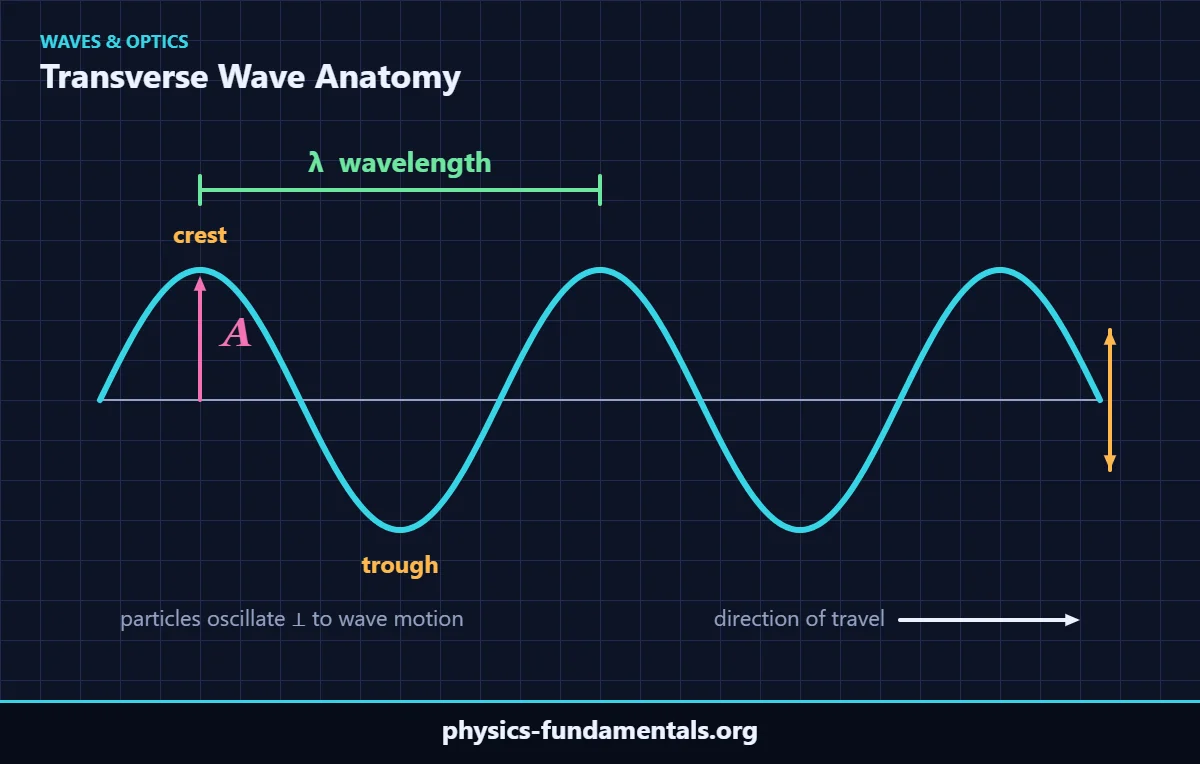
- In transverse waves the vibration is at right angles to the direction of travel; in longitudinal waves it is along it.
- The wave equation v = fλ applies to all waves, from sound to light.
- When light enters a new material it changes speed and bends: n₁ sin θ₁ = n₂ sin θ₂.
- Interference and diffraction are proof that light behaves as a wave.
In this guide
- What Is a Wave?
- Transverse vs Longitudinal Waves
- Key Wave Properties
- Sound Waves and the Doppler Effect
- The Electromagnetic Spectrum
- Reflection of Light
- Refraction and Snell’s Law
- Interference and Diffraction
- Lenses and Images
- Common Mistakes With Waves and Optics
- Why Study Waves and Optics?
- Frequently asked questions
Waves are everywhere. Sound reaches your ears as a wave, light from your screen arrives as a wave, and your phone talks to the network using radio waves. Even earthquakes travel through the ground as waves. Understanding a few shared ideas lets you explain all of them.
This guide covers the basic properties of waves, the difference between transverse and longitudinal waves, sound, the electromagnetic spectrum and the main ideas of optics: reflection, refraction, total internal reflection, interference and lenses.
What Is a Wave?
A wave is a disturbance that carries energy from one place to another. The particles of the material (the medium) vibrate around fixed positions, but they do not travel with the wave. Think of a stadium wave: the people only stand up and sit down, yet the wave moves all the way around the stadium.
Mechanical waves, such as sound and water waves, need a medium. Electromagnetic waves, such as light and radio, can travel through empty space.
Transverse vs Longitudinal Waves
| Feature | Transverse wave | Longitudinal wave |
|---|---|---|
| Direction of vibration | At right angles to the direction of travel | Parallel to the direction of travel |
| Made of | Crests and troughs | Compressions and rarefactions |
| Examples | Light, all electromagnetic waves, waves on a string, ripples | Sound, ultrasound, P-waves in earthquakes |
| Can be polarised? | Yes | No |
Tip: Polarised sunglasses work only because light is a transverse wave. They block light vibrating in one direction, which cuts glare from water and roads.
Key Wave Properties
- Amplitude (A): the maximum displacement from the rest position. Larger amplitude means more energy, so louder sound or brighter light.
- Wavelength (λ): the distance between two matching points, such as crest to crest, in metres.
- Frequency (f): how many waves pass a point each second, in hertz (Hz).
- Period (T): the time for one complete wave, in seconds. T = 1 ÷ f.
- Wave speed (v): how fast the wave travels, in m/s.
The wave equation
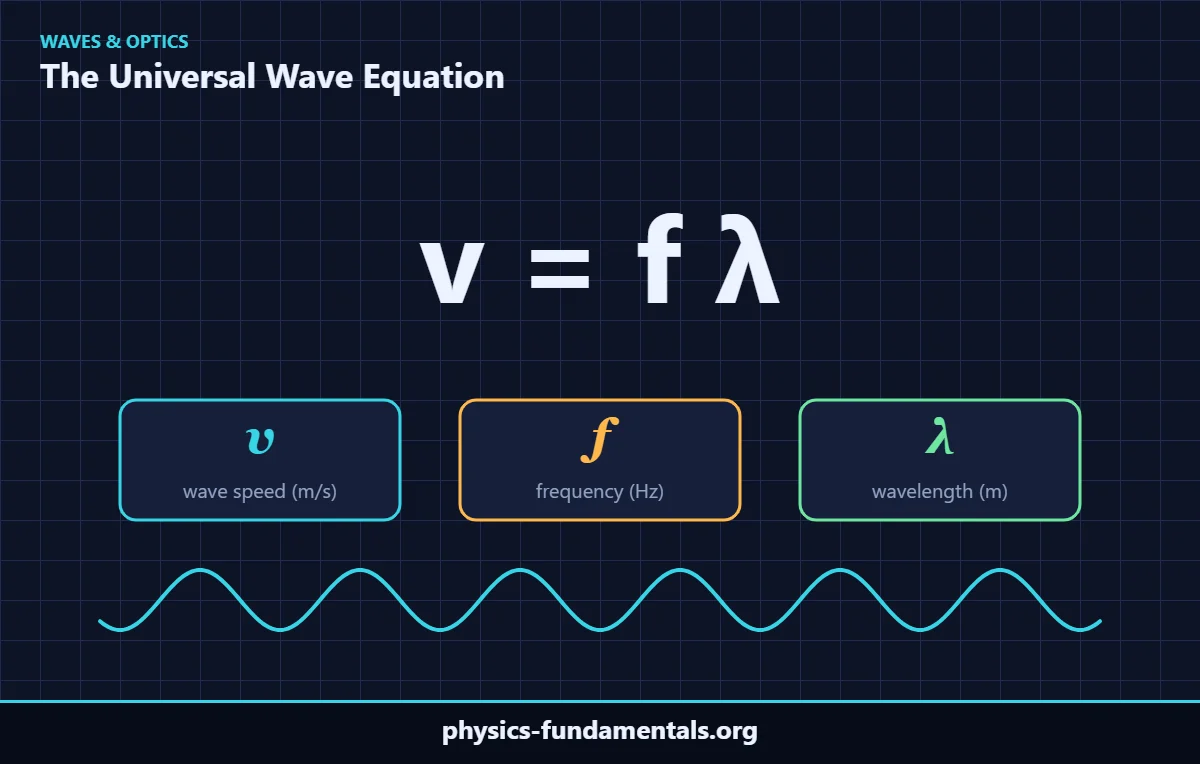
v = fλ
Wave speed equals frequency multiplied by wavelength. The medium sets the speed, so in one medium a higher frequency means a shorter wavelength.
Worked example: wavelength of a sound
Question: Sound travels through air at about 340 m/s. What is the wavelength of a 680 Hz note?
- Rearrange v = fλ to λ = v ÷ f.
- λ = 340 ÷ 680.
- λ = 0.5 m.
Answer: The wavelength is 0.5 m.
Worked example: wavelength of a radio wave
Question: An FM radio station broadcasts at 100 MHz. Radio waves travel at 3.0 × 10⁸ m/s. Find the wavelength.
- f = 100 MHz = 1.0 × 10⁸ Hz.
- λ = v ÷ f = 3.0 × 10⁸ ÷ 1.0 × 10⁸.
- λ = 3 m.
Answer: The wavelength is 3 m.
Sound Waves and the Doppler Effect
Sound is a longitudinal mechanical wave. It travels faster in solids than in liquids, and faster in liquids than in gases, because the particles are closer together. In air at room temperature it moves at roughly 340 m/s, while in steel it travels at around 5,000 m/s. Sound cannot travel through a vacuum.
Pitch depends on frequency: higher frequency means higher pitch. Loudness depends on amplitude. Humans hear roughly 20 Hz to 20,000 Hz; sound above that range is called ultrasound and is used in medical scans.
The Doppler effect is the change in observed frequency when a source moves relative to a listener. As an ambulance approaches, the waves bunch up and the siren sounds higher. As it moves away, the waves spread out and the pitch drops. Astronomers use the same effect with light to measure how fast galaxies are moving.
The Electromagnetic Spectrum
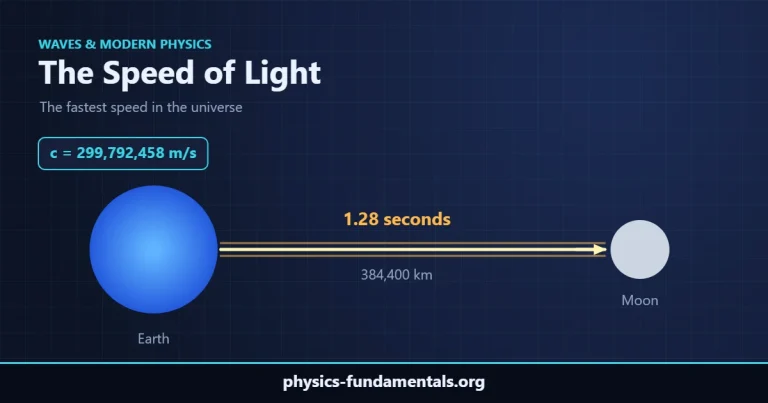
Light is just one part of a family of transverse waves called electromagnetic waves. All of them travel through a vacuum at the speed of light, c ≈ 3.0 × 10⁸ m/s. They differ only in wavelength and frequency.
| Type (longest to shortest wavelength) | Typical use |
|---|---|
| Radio waves | TV and radio broadcasting, communication |
| Microwaves | Cooking, mobile phones, satellite links |
| Infrared | Heaters, remote controls, thermal cameras |
| Visible light | Seeing, photography, optical fibres |
| Ultraviolet | Sterilising, detecting forged banknotes |
| X-rays | Medical imaging of bones |
| Gamma rays | Cancer treatment, sterilising equipment |
Common mistake: Higher frequency means higher energy. Ultraviolet, X-rays and gamma rays carry enough energy to damage living cells, so exposure must be limited.
Reflection of Light
When light bounces off a surface, the angle of incidence equals the angle of reflection. Both angles are measured from the normal, an imaginary line at right angles to the surface. A smooth surface like a mirror gives a clear image; a rough surface scatters light in many directions, which is called diffuse reflection.
Refraction and Snell’s Law
Refraction is the bending of light as it passes from one material into another. It happens because light changes speed. Light slows down in glass or water, so it bends toward the normal when it enters them, and away from the normal when it leaves.
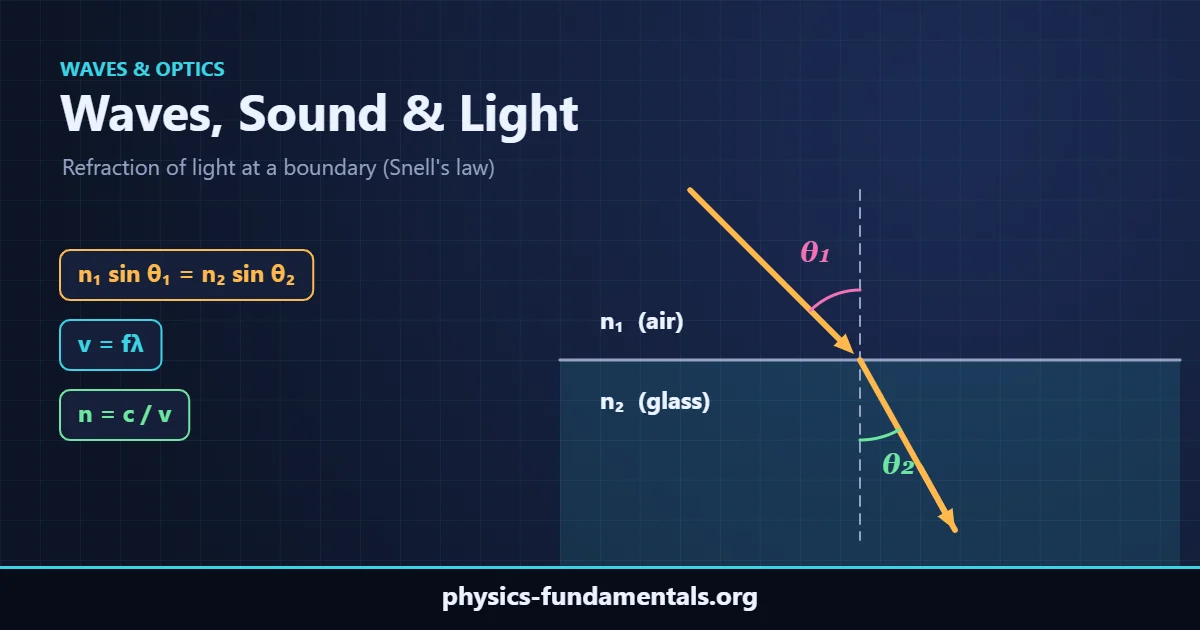
n₁ sin θ₁ = n₂ sin θ₂
n is the refractive index of each material (n = c ÷ v) and θ is the angle from the normal. Air has n ≈ 1.0, water about 1.33 and glass about 1.5.
Worked example: light entering glass
Question: A ray of light in air hits a glass block (n = 1.5) at 45° to the normal. What is the angle of refraction?
- Use n₁ sin θ₁ = n₂ sin θ₂: 1.0 × sin 45° = 1.5 × sin θ₂.
- sin θ₂ = 0.707 ÷ 1.5 ≈ 0.471.
- θ₂ = sin⁻¹(0.471).
Answer: θ₂ ≈ 28°, so the ray bends toward the normal.
Total internal reflection
When light travels from a denser material to a less dense one, it bends away from the normal. If the angle is larger than the critical angle, no light escapes and it all reflects back inside. For glass in air, sin C = 1 ÷ 1.5, so C ≈ 42°. Optical fibres use this effect to carry internet data as pulses of light over very long distances.
Interference and Diffraction
When two waves meet, they add together. This is the principle of superposition. If crests meet crests, the waves reinforce each other (constructive interference). If crests meet troughs, they cancel (destructive interference). Noise-cancelling headphones use destructive interference.
Diffraction is the spreading of waves as they pass through a gap or around an edge. It is strongest when the gap is about the same size as the wavelength. This is why you can hear someone around a corner even when you cannot see them.
Worked example: Young’s double-slit experiment
Question: Light of wavelength 600 nm passes through two slits 0.30 mm apart onto a screen 2.0 m away. What is the spacing between bright fringes?
- Use fringe spacing x = λD ÷ d.
- x = (600 × 10⁻⁹ × 2.0) ÷ (0.30 × 10⁻³).
- x = 4.0 × 10⁻³ m.
Answer: The bright fringes are 4.0 mm apart.
Lenses and Images
A converging (convex) lens bends parallel rays inward so they meet at the focal point. It is used in magnifying glasses, cameras and glasses for long-sightedness. A diverging (concave) lens spreads rays outward and is used to correct short-sightedness.
The lens equation links the focal length f, the object distance u and the image distance v: 1/f = 1/u + 1/v. Different textbooks use different sign conventions, so always follow the one your course uses. The power of a lens in dioptres is P = 1 ÷ f, with f in metres.
Common Mistakes With Waves and Optics
- Thinking that waves carry matter along with them.
- Measuring angles from the surface instead of from the normal.
- Forgetting to convert MHz, nm or mm into base SI units.
- Believing that frequency changes when a wave enters a new medium. The frequency stays the same; the speed and wavelength change.
- Mixing up which way light bends when it speeds up or slows down.
Why Study Waves and Optics?
Waves and optics connect many of the technologies you use every day. Your phone, Wi-Fi router and microwave oven all rely on electromagnetic waves, while cameras, glasses, microscopes and telescopes are built on the rules of optics. Learning waves and optics therefore helps you understand how information and energy move around the modern world.
Waves and optics also link to other branches of physics. The idea of a wave appears again in quantum physics, where electrons behave like waves, and in electromagnetism, where light is explained as a changing electric and magnetic field. A solid grasp of waves and optics makes those later topics far easier to follow.
Frequently Asked Questions
What is the difference between waves and optics?
Waves is the general study of how energy travels as vibrations, including sound and water waves. Optics is the part of wave physics that focuses on light: reflection, refraction, lenses, interference and diffraction.
What is the wave equation?
The wave equation is v = fλ. Wave speed (m/s) equals frequency (Hz) multiplied by wavelength (m). It applies to every type of wave.
Is light a transverse or longitudinal wave?
Light is a transverse electromagnetic wave. Its electric and magnetic fields vibrate at right angles to the direction it travels, which is why light can be polarised.
Why does light bend when it enters water?
Light travels more slowly in water than in air. When it enters at an angle, one side of the wavefront slows down first, so the whole ray changes direction toward the normal.
What is total internal reflection used for?
It is used in optical fibres for internet and medical endoscopes, in binocular prisms and in the sparkle of cut diamonds.