Projectile Motion Explained: Formulas, Range, Maximum Height and Examples
Quick answer
Projectile motion is the curved path an object follows when it is launched into the air and moves only under gravity. The horizontal motion has constant velocity, the vertical motion has a constant downward acceleration of g = 9.81 m/s², and together they produce a parabola.
Key takeaways
- Split the launch velocity into horizontal (v₀ cos θ) and vertical (v₀ sin θ) parts.
- Horizontal velocity stays constant; vertical velocity changes by 9.81 m/s every second.
- Time links the horizontal and vertical motion.
- On level ground: T = 2v₀ sin θ ÷ g, H = v₀² sin²θ ÷ 2g and R = v₀² sin 2θ ÷ g.
- A 45° launch gives the greatest range on level ground, if air resistance is ignored.
In this guide
- What Is Projectile Motion?
- Splitting the Motion Into Components
- Key Formulas: Range, Height and Time of Flight
- Worked Example 1: Horizontal Launch
- Worked Example 2: Angled Launch on Level Ground
- Worked Example 3: Launch From a Height
- Why 45° Gives the Maximum Range
- The Effect of Air Resistance
- Common Mistakes in Projectile Questions
- Finding the Velocity at Any Point
- Projectiles in Sport and Everyday Life
- Frequently asked questions
A basketball arcing towards the hoop, water from a garden hose, a long jumper in mid-air: all of these follow the same kind of curved path. Physicists call them projectiles, and their motion can be predicted with a handful of simple equations.
The key idea is that horizontal and vertical motion happen independently. Once you split the motion into these two parts, a problem that looks complicated becomes two easy ones. This guide shows you how, step by step, with worked examples and a free projectile motion calculator.
What Is Projectile Motion?
A projectile is any object that, once launched, is acted on only by gravity. In the simple model used in most courses, air resistance is ignored, the ground is flat and g is constant. Under these assumptions, every projectile follows a parabolic path.
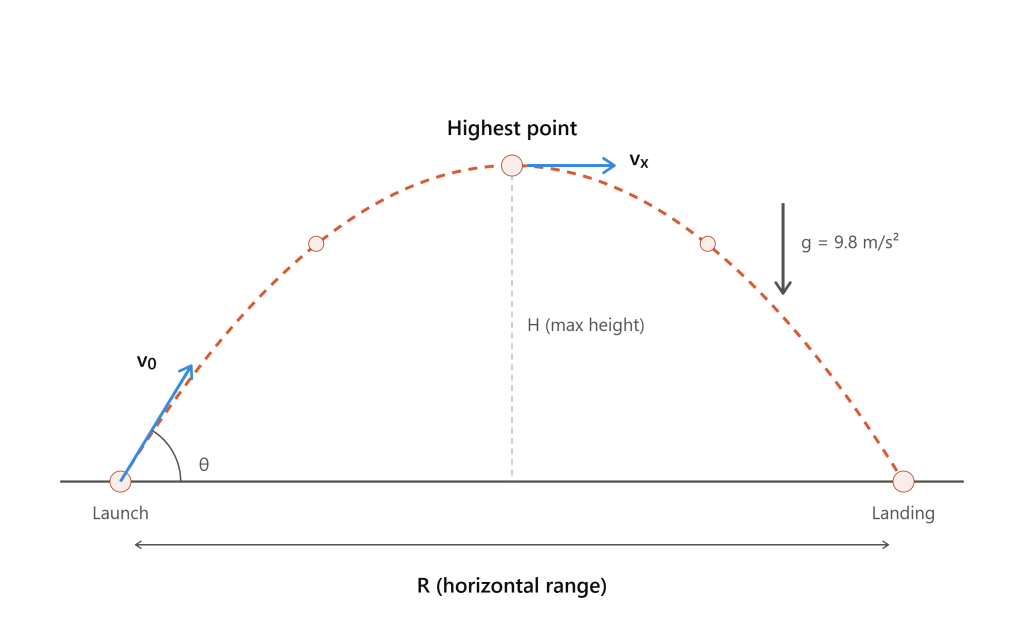
There are three common types of projectile question:
- Horizontal launch: an object leaves a cliff, table or plane moving horizontally.
- Angled launch on level ground: an object is launched at an angle and lands at the same height.
- Angled launch from a height: an object is launched at an angle and lands lower than where it started.
Splitting the Motion Into Components
The most important step is to break the launch velocity v₀ into two perpendicular parts using trigonometry.
vₓ = v₀ cos θ vᵧ = v₀ sin θ
θ is the launch angle above the horizontal. vₓ is the horizontal component, and vᵧ is the initial vertical component.
| Horizontal | Vertical | |
|---|---|---|
| Acceleration | 0 | −g (taking up as positive) |
| Velocity | Constant: vₓ = v₀ cos θ | Changes: v = v₀ sin θ − gt |
| Displacement | x = vₓt | y = v₀ sin θ × t − ½gt² |
| Equations to use | distance = speed × time | SUVAT equations |
Tip: Time is the only quantity shared by both directions. Most questions are solved by finding t from one direction and then using it in the other.
Key Formulas: Range, Height and Time of Flight
For a projectile launched and landing at the same height, three standard results come directly from the components.
T = 2v₀ sin θ ÷ g
Time of flight: the time to go up and come back down to the launch height.
H = v₀² sin²θ ÷ 2g
Maximum height: reached when the vertical velocity becomes zero, halfway through the flight.
R = v₀² sin 2θ ÷ g
Range: the horizontal distance travelled before landing.
These formulas only apply on level ground. If the landing point is lower or higher than the launch point, go back to the components and solve the vertical motion with SUVAT, as the SUVAT equations guide explains.
Try it yourself: Projectile motion calculator — works for level ground and for launches from a height.
Worked Example 1: Horizontal Launch
Worked example: a ball rolling off a table
Question: A ball rolls off a 1.25 m high table at 3 m/s. How long does it take to hit the floor, and how far from the table does it land?
- Vertical motion: u = 0, a = 9.81 m/s² downward, s = 1.25 m. Use s = ½at².
- 1.25 = ½ × 9.81 × t², so t² = 0.2548 and t ≈ 0.505 s.
- Horizontal motion: x = vₓt = 3 × 0.505.
Answer: The ball lands after about 0.50 s, roughly 1.5 m from the table.
Notice that the horizontal speed does not change the time of the fall. A ball dropped straight down from the same height would land at exactly the same moment.
Worked Example 2: Angled Launch on Level Ground
Worked example: a javelin throw
Question: A javelin is thrown at 25 m/s at 40° above the horizontal. Ignoring air resistance and the thrower’s height, find its time of flight, maximum height and range.
- vₓ = 25 cos 40° ≈ 19.15 m/s and vᵧ = 25 sin 40° ≈ 16.07 m/s.
- T = 2vᵧ ÷ g = 2 × 16.07 ÷ 9.81 ≈ 3.28 s.
- H = vᵧ² ÷ 2g = 16.07² ÷ 19.62 ≈ 13.2 m.
- R = vₓ × T = 19.15 × 3.28 ≈ 62.8 m.
Answer: Time of flight ≈ 3.28 s, maximum height ≈ 13.2 m and range ≈ 62.8 m.
Worked Example 3: Launch From a Height
Worked example: a stone thrown from a cliff
Question: A stone is thrown at 12 m/s at 30° above the horizontal from the top of a 20 m cliff. How far from the base of the cliff does it land?
- vₓ = 12 cos 30° ≈ 10.39 m/s and vᵧ = 12 sin 30° = 6 m/s (upward).
- Vertical motion, up positive: −20 = 6t − 4.905t². Rearrange: 4.905t² − 6t − 20 = 0.
- Quadratic formula: t = (6 + √(36 + 392.4)) ÷ 9.81 ≈ (6 + 20.70) ÷ 9.81 ≈ 2.72 s.
- Horizontal distance: x = 10.39 × 2.72 ≈ 28.3 m.
Answer: The stone lands about 28 m from the base of the cliff, after about 2.7 s.
Why 45° Gives the Maximum Range
On level ground, the range is R = v₀² sin 2θ ÷ g. The sine function has its largest value, 1, when its angle is 90°. So the range is greatest when 2θ = 90°, that is, θ = 45°. The maximum range is then Rmax = v₀² ÷ g.
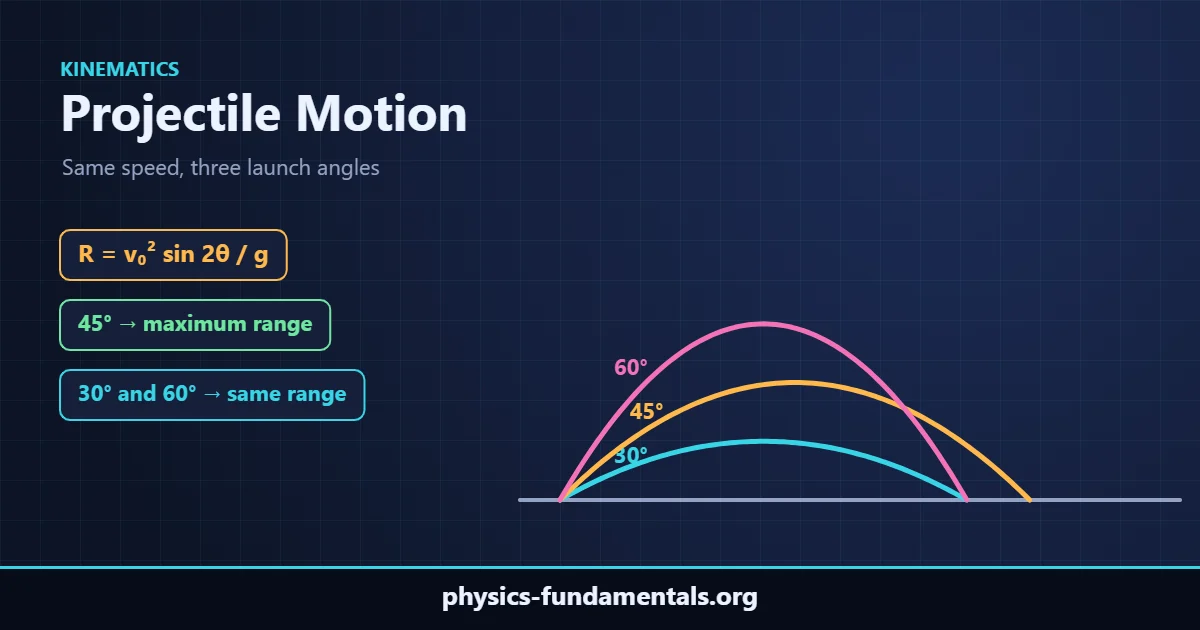
Angles that add up to 90° give equal ranges. A ball launched at 30° lands in the same place as one launched at 60°, but the 60° ball flies higher and stays in the air longer.
Common mistake: Assuming 45° is always best. If you launch from a height, the best angle is less than 45°. In real sports, air resistance and the athlete’s body also change the ideal angle; shot putters, for example, usually release at around 35° to 40°.
The Effect of Air Resistance
In real life, air resistance acts against the motion. It reduces both the horizontal and vertical speeds, so the projectile does not travel as far or as high as the simple model predicts. The path also stops being a perfect parabola: the way down becomes steeper than the way up. For light objects like badminton shuttles, the effect is huge; for heavy, compact objects over short distances, it is small.
Common Mistakes in Projectile Questions
- Using the full launch speed in vertical equations instead of v₀ sin θ.
- Giving the horizontal motion an acceleration.
- Forgetting that the vertical velocity at the top is zero, but the horizontal velocity is not.
- Using the level-ground range formula when the launch and landing heights are different.
- Leaving the calculator in radians when the angle is in degrees.
Finding the Velocity at Any Point
Sometimes a question asks for the speed or direction of a projectile at a particular moment, such as just before it lands. Find the two components at that time, then combine them.
- Horizontal component: vₓ = v₀ cos θ (it never changes).
- Vertical component at time t: vᵧ = v₀ sin θ − gt (taking up as positive).
- Speed: v = √(vₓ² + vᵧ²), using Pythagoras.
- Direction: the angle below the horizontal is tan⁻¹(|vᵧ| ÷ vₓ).
For the stone thrown from the cliff in example 3, at t = 2.72 s the vertical velocity is 6 − 9.81 × 2.72 ≈ −20.7 m/s. Combining it with vₓ = 10.39 m/s gives an impact speed of about √(10.39² + 20.7²) ≈ 23.2 m/s, at roughly 63° below the horizontal.
Projectiles in Sport and Everyday Life
- Football and basketball: players learn by practice the launch speed and angle that land the ball on target. A higher arc gives a basketball a bigger target area as it comes down into the hoop.
- Long jump: the jumper is a projectile once they leave the board. Speed down the runway matters more than angle, so most jumpers take off at around 20°.
- Water fountains and hoses: each drop of water follows its own parabola, which is why fountain jets form such clear curves.
- Fireworks: the shell follows a projectile path before it explodes at the highest point, where it is moving most slowly.
- Aid drops: supplies released from a moving plane keep the plane’s horizontal velocity, so they must be released well before the plane is above the target.
Practise this topic: try these projectile motion MCQs for exam practice with full solutions and this projectile motion guide with range and time of flight numericals.
Frequently Asked Questions
What is projectile motion?
Projectile motion is the motion of an object launched into the air that moves only under gravity. Its path is a parabola when air resistance is ignored.
What are the formulas for projectile motion?
On level ground: time of flight T = 2v₀ sin θ ÷ g, maximum height H = v₀² sin²θ ÷ 2g and range R = v₀² sin 2θ ÷ g. The horizontal velocity is v₀ cos θ and stays constant.
Why is the horizontal velocity of a projectile constant?
Because, ignoring air resistance, no horizontal force acts on the projectile. With no force there is no acceleration, so the horizontal velocity does not change.
What angle gives the maximum range?
On level ground, 45°. When launching from above the landing level, the best angle is a little less than 45°.
What is the velocity at the highest point?
The vertical velocity is zero at the highest point, but the projectile still moves horizontally at v₀ cos θ, so its speed is not zero.