Speed of Light: How Fast Is Light and How Was It Measured?
Quick answer
The speed of light in a vacuum is exactly 299,792,458 metres per second, about 300,000 km every second or roughly 1.08 billion km/h. It is given the symbol c. Light slows down inside materials such as water and glass, but nothing that carries energy or information can travel faster than c.
Key takeaways
- c = 299,792,458 m/s exactly, usually rounded to 3.0 × 10⁸ m/s.
- Every electromagnetic wave, from radio to gamma rays, travels at c in a vacuum.
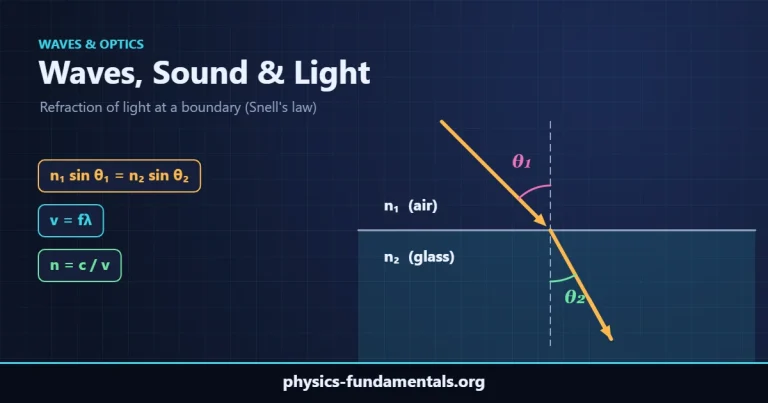
- In a material, light travels at v = c ÷ n, where n is the refractive index.
- Light from the Sun takes about 8 minutes 20 seconds to reach Earth.
- According to special relativity, no object with mass can reach the speed of light.
In this guide
- What Is the Speed of Light?
- How Did Scientists First Measure c?
- How Fast Does Light Travel in Water and Glass?
- Light Travel Times and the Light-Year
- Why Can Nothing Travel Faster Than Light?
- Why Light Speed Matters in Everyday Life
- Light, Radio and X-Rays All Travel at c
- Exam Tips: Light Travel Time and Refractive Index Questions
- Frequently asked questions
When you switch on a light, the room seems to brighten instantly. For most of human history, people thought light simply arrived everywhere at once. It was only in the 1600s that scientists showed light takes time to travel, and it took another three centuries to measure its speed precisely.
Today light speed is one of the most important numbers in science. It sets the scale of the universe, links mass to energy through E = mc², and keeps your phone’s GPS accurate. This guide explains its exact value, how it was measured, how it changes in different materials and why it acts as a cosmic speed limit.
What Is the Speed of Light?
Light speed is how fast light and all other electromagnetic waves travel through empty space. Its value is exactly 299,792,458 m/s. It is exact because, since 1983, the metre itself has been defined as the distance light travels in a vacuum in 1/299,792,458 of a second.
| Unit | Value (approximate) |
|---|---|
| metres per second | 3.00 × 10⁸ m/s |
| kilometres per second | 299,792 km/s |
| kilometres per hour | 1.08 × 10⁹ km/h |
| miles per second | 186,282 mi/s |
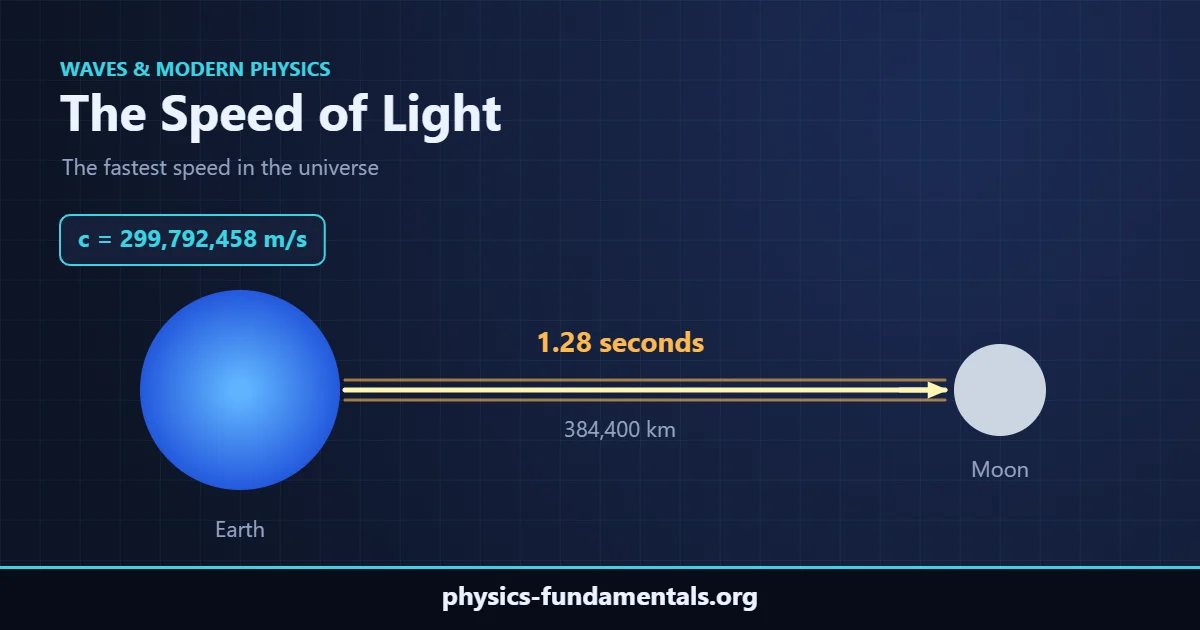
To picture how fast that is: light could travel around Earth’s equator about 7.5 times in a single second.
How Did Scientists First Measure c?
Measuring something that fast was a real challenge. Each new method gave a more accurate value.
| Year | Scientist | Method | Result (approx.) |
|---|---|---|---|
| 1638 | Galileo Galilei | Two people flashing lanterns between hilltops | Too fast to measure |
| 1676 | Ole Rømer | Timing eclipses of Jupiter’s moon Io | About 220,000 km/s |
| 1849 | Hippolyte Fizeau | Light through a rapidly spinning toothed wheel | About 313,000 km/s |
| 1862 | Léon Foucault | Rotating mirror | About 298,000 km/s |
| 1926 | Albert Michelson | Improved rotating mirrors over 35 km | About 299,796 km/s |
| 1983 | International agreement | Speed fixed by definition | 299,792.458 km/s exactly |
Rømer noticed that Io’s eclipses came later than predicted when Earth was moving away from Jupiter. He realised the delay was the extra time light needed to cross the larger distance. It was the first proof that light has a finite speed.
How Fast Does Light Travel in Water and Glass?
Light slows down when it passes through matter, because it interacts with the atoms along the way. The amount it slows down is described by the refractive index, n.
v = c ÷ n
v is light speed in the material, c is the speed in a vacuum and n is the refractive index (always 1 or more).
| Material | Refractive index (n) | Speed |
|---|---|---|
| Vacuum | 1 (exactly) | 299,792 km/s |
| Air | 1.0003 | about 299,700 km/s |
| Water | 1.33 | about 225,000 km/s |
| Glass | about 1.5 | about 200,000 km/s |
| Diamond | 2.42 | about 124,000 km/s |
This change of speed is what causes refraction, the bending of light at a boundary. It is why a straw looks bent in a glass of water and why diamonds sparkle so brightly.
Worked example: light in glass
Question: How fast does light travel in glass with a refractive index of 1.5?
- Use v = c ÷ n.
- v = 3.0 × 10⁸ ÷ 1.5.
- v = 2.0 × 10⁸ m/s.
Answer: Light travels at about 2.0 × 10⁸ m/s in glass, two thirds of its speed in a vacuum.
Light Travel Times and the Light-Year
Because light takes time to travel, when you look at the sky you are seeing the past. You see the Moon as it was about 1.3 seconds ago and the Sun as it was over 8 minutes ago.
t = d ÷ c
The time for light to travel a distance d. Make sure d is in metres when c is in m/s, or use c = 299,792 km/s with d in km.
Worked example: sunlight
Question: The average distance from the Sun to Earth is 1.496 × 10¹¹ m. How long does sunlight take to arrive?
- t = d ÷ c = 1.496 × 10¹¹ ÷ 2.998 × 10⁸.
- t ≈ 499 s.
- 499 ÷ 60 ≈ 8.3 minutes.
Answer: About 8 minutes and 19 seconds.
For distances between stars, astronomers use the light-year: the distance light travels in one year. It is about 9.46 × 10¹² km. The nearest star beyond the Sun, Proxima Centauri, is about 4.2 light-years away, so its light is over four years old when it reaches us.
Worked example: one light-year
Question: Show that a light-year is about 9.46 × 10¹⁵ m.
- One year ≈ 365.25 × 24 × 3,600 ≈ 3.156 × 10⁷ s.
- Distance = c × t = 2.998 × 10⁸ × 3.156 × 10⁷.
- Distance ≈ 9.46 × 10¹⁵ m.
Answer: A light-year is about 9.46 × 10¹⁵ m, or 9.46 trillion km.
Try it yourself: Speed of light calculator — find light travel times, distances and light speed in any material.
Why Can Nothing Travel Faster Than Light?
Einstein’s theory of special relativity starts from the idea that light speed is the same for every observer, no matter how fast they are moving. One consequence is that as an object with mass speeds up, the energy needed to accelerate it further grows without limit. Reaching c would take infinite energy, so it can never happen.
Other strange effects follow from the same idea. Moving clocks tick more slowly (time dilation), moving objects are shorter in their direction of travel (length contraction), and mass and energy are linked by E = mc². The c in that famous equation is light speed.
Common mistake: Saying that light is “infinitely fast” or that it arrives instantly. Over everyday distances the delay is tiny, but it is always there and becomes very noticeable across space.
Why Light Speed Matters in Everyday Life
- GPS navigation: your phone works out its position by timing radio signals from satellites. An error of one microsecond would put you about 300 m off.
- Fibre-optic internet: data travels as light pulses through glass at about 200,000 km/s.
- Radar and lidar: speed cameras and self-driving cars measure distance by timing reflected waves.
- Measuring the Moon: scientists bounce lasers off mirrors left by the Apollo astronauts. The round trip takes about 2.56 s and reveals the Moon’s distance to within millimetres.
- Thunderstorms: you see lightning almost instantly but hear thunder later, because sound is nearly a million times slower. Count the seconds and divide by 3 to estimate the distance in kilometres.
Light, Radio and X-Rays All Travel at c
Visible light is only a small part of the electromagnetic spectrum. Radio waves, microwaves, infrared, ultraviolet, X-rays and gamma rays are all the same kind of wave, made of changing electric and magnetic fields. In a vacuum they all travel at exactly the same speed, c. What makes them different is their frequency and wavelength.
The wave equation links these quantities: c = fλ. A radio station broadcasting at 100 MHz sends out waves 3 m long, while green light, with a frequency of about 6 × 10¹⁴ Hz, has a wavelength of only about 500 nm. You can try these numbers in the wave speed calculator.
| Wave | Typical wavelength | Speed in a vacuum |
|---|---|---|
| Radio | 1 m to 1 km | c |
| Microwave | 1 mm to 30 cm | c |
| Visible light | 400 to 700 nm | c |
| X-ray | about 0.01 to 10 nm | c |
Exam Tips: Light Travel Time and Refractive Index Questions
Questions on light speed usually test one of three skills: using t = d ÷ c, using v = c ÷ n, or using c = fλ. A few habits make them straightforward.
- Write c = 3.0 × 10⁸ m/s unless the question gives a more precise value.
- Convert every distance to metres and every time to seconds before substituting.
- Use standard form on your calculator to avoid typing mistakes with long strings of zeros.
- Check that your answer makes sense: light in a material must be slower than c, and n must be 1 or more.
- Round your final answer to the same number of significant figures as the data in the question.
Tip: If a question mentions a radar or laser “echo”, remember that the signal travels there and back. Halve the total time before calculating the distance.
Practise this topic: check your understanding with speed of light MCQs with answers for physics exams and learn more about the electromagnetic spectrum and the properties of each type of wave.
Frequently Asked Questions
What is the speed of light in m/s?
The speed of light in a vacuum is exactly 299,792,458 m/s, commonly rounded to 3.0 × 10⁸ m/s.
Does light always travel at the same speed?
In a vacuum it is always the same for every observer. In a material such as water or glass, light travels more slowly, at c divided by the refractive index.
How long does light take to get from the Moon to Earth?
About 1.28 seconds, because the Moon is around 384,400 km away.
Can anything travel faster than light?
No object with mass can reach or exceed the speed of light in a vacuum. Special relativity shows it would need infinite energy.
Why is the speed of light called c?
The symbol c is thought to come from the Latin word celeritas, meaning swiftness or speed.